Tax Operations Software in Nigeria: Automate Tax Payments, Compliance and Reporting
Managing taxes is one of those responsibilities that businesses cannot afford to overlook. From calculating tax liabilities and tracking payment deadlines to preparing reports and keeping financial records, tax compliance involves several tasks that require time, accuracy and proper organisation.
For small businesses, these responsibilities may fall on the business owner or a finance officer who already has other duties to manage. Larger organisations may have dedicated finance teams, but handling multiple tax obligations across departments can still be challenging, especially when information is scattered across spreadsheets, emails and different accounting systems.
This is where tax operations software becomes useful. By bringing important tax processes into a more organised digital environment, businesses can reduce repetitive administrative work, monitor their obligations and improve the way they manage tax compliance.
In Nigeria, where businesses must navigate applicable federal and state tax requirements, having a reliable system for managing tax information can make a meaningful difference. The right software can help businesses stay organised, identify potential compliance issues earlier and make better decisions about their tax responsibilities.
This article explores how tax operations software works, the features businesses should look for and how automation can improve tax payments, compliance and reporting.
What Is Tax Operations Software?
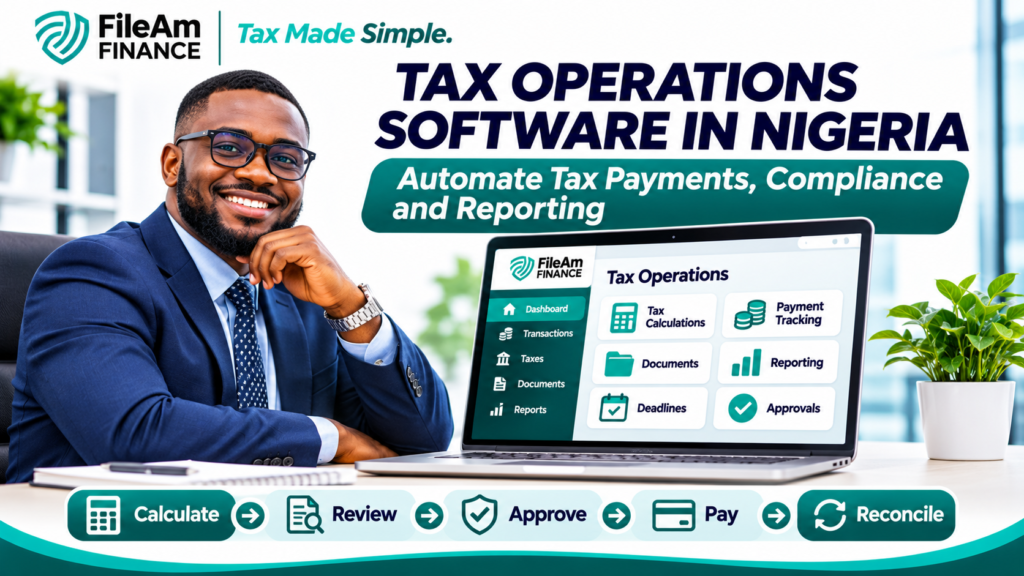
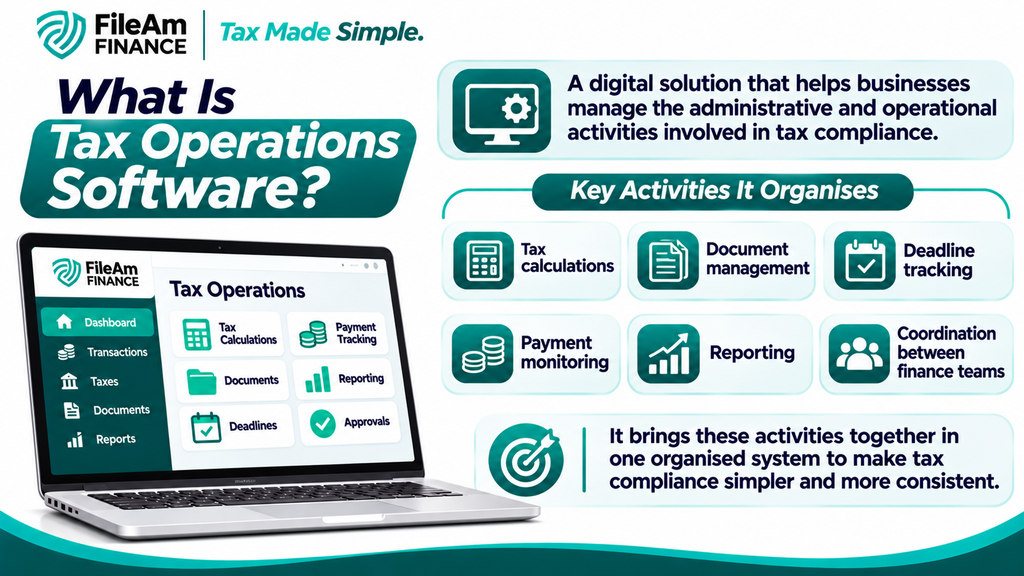
Tax operations software is a digital solution that helps businesses manage the administrative and operational activities involved in tax compliance. These activities may include tax calculations, document management, deadline tracking, payment monitoring, reporting and coordination between finance teams.
Rather than handling every task separately, businesses can use software to organise information and establish a more consistent process for managing their tax obligations.
For example, a company that previously relied on spreadsheets to track tax deadlines could use software to centralise its records, set reminders and monitor the status of outstanding tasks. This makes it easier for the finance team to see what has been completed and what still requires attention.
However, tax operations software is not necessarily the same as a tax filing portal or a basic accounting application. A filing portal may focus on submitting returns and making payments, while accounting software primarily records financial transactions. A broader tax operations solution can help coordinate several activities involved in keeping tax processes organised.
The features available will depend on the product. Businesses should therefore assess whether a platform supports their actual needs rather than assuming that every solution offers complete automation.
Why Nigerian Businesses Need Tax Operations Software
Managing tax obligations manually can become difficult as a business grows. More transactions, additional employees, multiple reporting periods and changing compliance requirements can increase the amount of information that finance teams need to process.
Here are some reasons businesses may benefit from adopting tax operations software.
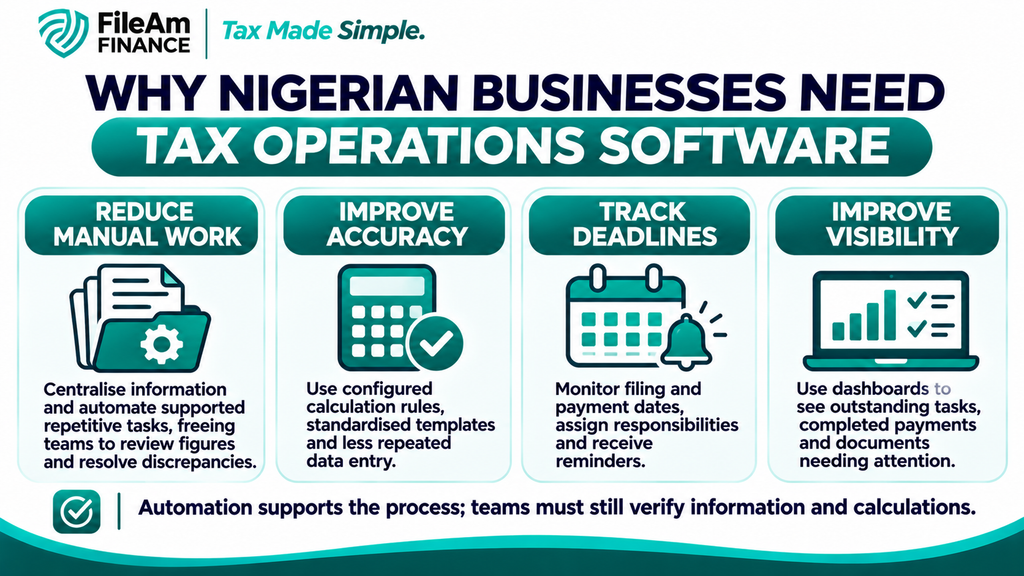
1. Reducing Manual Work
Manual tax management often involves collecting information from different sources, checking calculations, preparing documents and following up on approvals. These tasks can consume valuable time, particularly when the same information must be entered into several systems.
Tax operations software can reduce some of this repetitive work by centralising information and automating supported processes. Finance teams can then spend more time reviewing figures, resolving discrepancies and planning ahead.
2. Improving Accuracy
A small mistake in a tax calculation or payment record can create unnecessary administrative work. Incorrect figures may lead to inaccurate reports, underpayments or delays in reconciling tax accounts.
Software can help improve consistency by applying configured calculation rules, using standardised templates and reducing repeated data entry. However, automation does not eliminate every risk. Businesses must still verify the information entered, review calculations and ensure that the software reflects applicable tax rules.
3. Keeping Track of Deadlines
Missing a tax deadline can expose a business to additional charges or other compliance consequences, depending on the applicable law.
A tax operations system can help teams monitor upcoming filing and payment dates, assign responsibilities and receive reminders before deadlines arrive. This is especially useful when several employees are responsible for different parts of the compliance process.
4. Improving Visibility
When tax information is spread across different files and departments, it can be difficult to understand the company’s overall compliance position.
Centralised records and dashboards can give authorised team members a clearer picture of outstanding tasks, completed payments and documents that require attention.
This visibility helps management identify problems early instead of waiting until a deadline has passed.
Key Features to Look for in Tax Operations Software
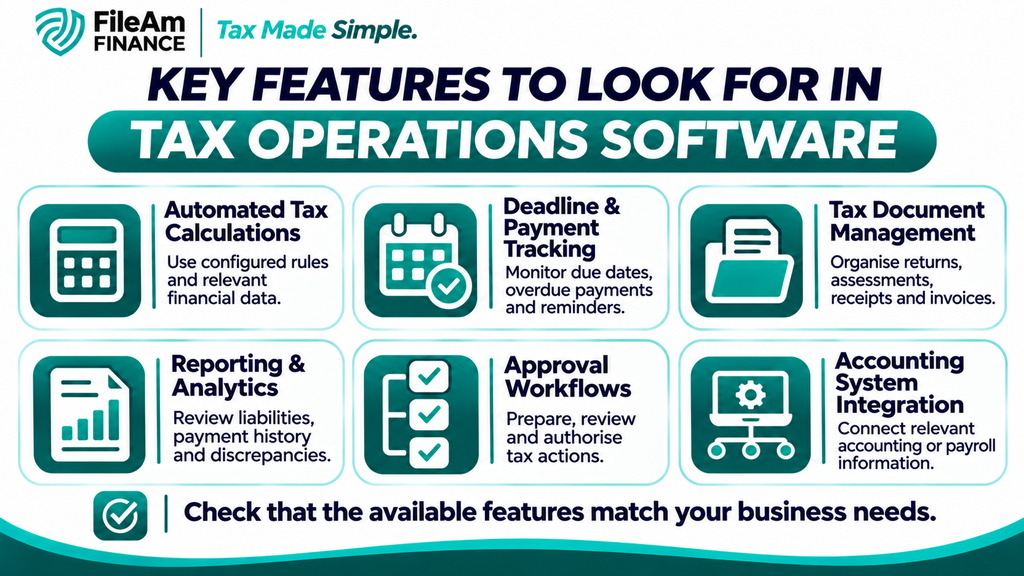
Not every business needs the same set of features. A small company with a straightforward tax structure may need a simple system for tracking obligations and storing records, while a larger organisation may require approval workflows, integrations and more detailed reporting.
When comparing tax operations software, consider the following features.
Automated Tax Calculations
Calculating tax manually can become time-consuming when a business handles numerous transactions, employee payments or different categories of tax.
Software with tax calculation capabilities can use configured rules and relevant financial data to help calculate tax liabilities. This can reduce repetitive work and make calculations more consistent.
Businesses should confirm that the solution supports the taxes they need to manage and that its rules can be updated when applicable requirements change.
Tax Deadline and Payment Tracking
A useful platform should help businesses track upcoming tax obligations and identify payments that are due or overdue.
For example, finance teams may be able to assign tasks, set reminders and monitor the status of each obligation. This reduces the likelihood of important deadlines being overlooked because someone forgot to send an email or update a spreadsheet.
Tax Document Management
Tax compliance generates a considerable amount of documentation, including returns, assessments, receipts, invoices and correspondence with tax authorities.
A document management feature allows businesses to organise these records in a central location. Searchable files, consistent naming conventions and controlled access can make it easier to retrieve documents when preparing reports or responding to queries.
Reporting and Analytics
Tax reporting software can help businesses summarise tax-related information, review payment histories and prepare internal reports.
Depending on the platform, users may be able to generate reports showing outstanding liabilities, upcoming deadlines, completed payments and unresolved discrepancies.
These reports help finance managers understand the company’s tax position and identify areas that need attention.
Approval Workflows
In some organisations, tax payments and returns must be reviewed by more than one person before they are submitted or paid.
Approval workflows allow businesses to assign responsibilities and define the steps required before an action can proceed. For instance, a finance officer may prepare a payment, a tax manager may review the supporting documents, and an authorised manager may approve the transaction.
This creates a clearer process and helps reduce the risk of unauthorised payments or incomplete reviews.
Integration With Accounting Systems
Tax operations software becomes more useful when it can exchange relevant information with a business’s existing accounting or payroll systems.
Integrations may reduce duplicate data entry and make it easier to reconcile financial information with tax records. However, businesses should confirm which integrations are available, whether additional fees apply and how errors or missing data are handled.
How Tax Operations Software Automates Tax Payments
Tax payment automation is one of the most practical ways businesses can improve their compliance processes. Rather than relying entirely on manual reminders and individual follow-ups, teams can use software to coordinate the steps leading up to a payment.
Here is how the process can work.
First, the business gathers the relevant financial information. This may come from accounting records, payroll systems, invoices or other approved sources.
Next, the tax team reviews the liability. Software may assist with calculations and highlight missing information, but the business should verify the figures and confirm the applicable requirements.
The payment is prepared for approval. Where approval workflows are available, the system can route the payment details to the appropriate reviewers.
The authorised person completes the payment. Depending on the software and its integrations, this may involve transferring payment details to an approved payment channel or accessing the relevant tax authority’s platform.
Finally, the business records and reconciles the transaction. Payment evidence is stored, and the tax team checks that the liability has been correctly credited.
It is important to understand that automating the payment workflow does not always mean that the software can directly pay taxes to the government. Some platforms support reminders, calculations and approvals but require users to complete payments through official channels.
Businesses should confirm the capabilities of a product before purchasing it.
Using Tax Compliance Software in Nigeria
Businesses looking for tax compliance software in Nigeria should consider how well a solution fits their tax responsibilities, internal processes and reporting needs.
Nigeria’s tax administration involves federal and state authorities, and the applicable requirements depend on factors such as the type of tax, the taxpayer and the relevant circumstances.
For this reason, businesses should avoid choosing software based only on general claims about automation. The platform should support the relevant tax processes and allow the business to verify information against current official requirements.
The following practices can help.
- Identify the taxes you need to manage. List the applicable tax obligations and the records required for each one.
- Review local and federal requirements. Confirm which authorities are responsible for the relevant taxes and which official payment channels must be used.
- Check how tax rules are maintained. Ask whether updates are provided when applicable regulations change and whether users can review the rules used for calculations.
- Confirm reporting capabilities. Make sure the software can generate reports that are useful for your finance team and auditors.
- Assess support and training. A platform is more useful when employees understand how to use it and know where to get help.
Businesses should also verify that any claimed integration with a tax authority or payment system is genuine and currently available.
Benefits of Tax Operations Management Software for SMEs
Small and medium-sized enterprises often operate with limited staff and tight budgets. A business owner may be responsible for sales, operations, customer service and financial administration, leaving little time to manage tax records manually.
Tax operations management software can help SMEs establish a more organised approach without necessarily building a large internal tax department.
For example, a growing retail business may use software to organise tax documents, monitor deadlines and keep track of payment confirmations. Its finance officer can review outstanding tasks from one place rather than checking several spreadsheets and email conversations.
A professional services firm may benefit from approval workflows that make it clear who is responsible for preparing, reviewing and authorising tax-related transactions.
The benefits can include:
- Less time spent on repetitive administrative tasks
- Better access to tax records and supporting documents
- Improved coordination between finance and management
- Greater visibility into outstanding tax obligations
- More consistent reporting and reconciliation
- Better preparation for tax reviews and audits
However, software is not a substitute for sound financial processes. SMEs still need accurate records, clearly assigned responsibilities and appropriate professional advice when dealing with complex tax matters.
How to Choose the Right Tax Operations Software for Your Business
Choosing the right software requires more than comparing prices or counting features. The solution should address the problems your business currently experiences and remain useful as the organisation grows.
Before making a decision, consider these factors.
Ease of use: The platform should be straightforward enough for your finance team to use consistently. A complicated system may create additional work instead of reducing it.
Scalability: Consider whether the software can accommodate more transactions, employees, tax obligations and users as your business expands.
Security: Tax records contain sensitive financial information. Look for appropriate access controls, secure storage, backup arrangements and clear data protection practices.
Pricing: Compare subscription fees, implementation costs, training charges and any additional fees for integrations or premium features. Choose a solution that fits your budget and delivers practical value.
Customer support: Reliable support is important when users encounter technical problems, need assistance with configuration or have questions about the platform’s features.
Compliance capabilities: Confirm that the software supports your relevant tax workflows and can accommodate applicable regulatory changes. Where professional tax advice is needed, establish whether it is included or must be obtained separately.
A useful approach is to identify your three biggest tax administration challenges and evaluate each product against them. This helps you choose a solution based on business needs rather than features you may never use.
How to Implement Tax Operations Software Successfully
Even a capable software platform will not deliver its full benefits if it is introduced without proper planning.
Start by reviewing your existing tax processes. Identify where delays occur, which tasks are repeated manually and where errors are most likely to happen.
Next, organise your tax records before migrating them into the new system. Incomplete or inconsistent data can affect calculations, reporting and reconciliation, so it is worth resolving obvious discrepancies early.
Assign responsibilities to the employees who will use the platform. Make sure they understand how to enter information, review calculations, manage approvals and store payment evidence.
It is also helpful to test the system with a limited number of workflows before rolling it out across the entire organisation. For example, you could begin with tax deadline tracking and document management before introducing more complex integrations.
Finally, review the results after implementation. Track whether the system has reduced administrative time, improved record retrieval or helped the team identify overdue obligations more quickly.
These measures make it easier to determine whether the software is delivering the improvements your business expected.
Why Businesses Should Invest in Better Tax Operations
Tax administration is not simply about meeting deadlines. It also affects financial planning, internal controls and the quality of information available to management.
When tax processes depend heavily on manual work, important information can be overlooked, records may become difficult to retrieve and employees can spend too much time coordinating routine tasks.
Tax operations software provides an opportunity to bring these activities into a more structured system. By combining deadline monitoring, document management, reporting and approval workflows, businesses can improve visibility and establish a more consistent approach to tax compliance.
For Nigerian businesses seeking to reduce administrative pressure, the right solution can support more efficient tax operations while allowing finance teams to focus on reviewing information and making informed decisions.
The key is to choose software that fits the business, verify its compliance capabilities and maintain appropriate human oversight.
Conclusion
Managing tax payments, documents, reporting and deadlines manually can become increasingly difficult as a business grows. Tax operations software helps address these challenges by bringing essential processes into a more organised digital environment.
From tax payment automation and document management to reporting and approval workflows, the right platform can reduce repetitive tasks, improve recordkeeping and help businesses monitor their compliance responsibilities.
For SMEs, it can provide a more structured way to manage tax obligations without adding unnecessary administrative complexity. For larger organisations, it can improve coordination across finance teams and support stronger internal controls.
If your business is still relying on scattered spreadsheets, email reminders and manual follow-ups, it may be time to evaluate a more efficient approach.
Explore tax operations software that fits your business needs. Compare available features, confirm the relevant compliance capabilities and choose a solution that helps your team manage tax obligations.