Tax Debt Recovery in Nigeria: How Tax Authorities Collect Unpaid Taxes
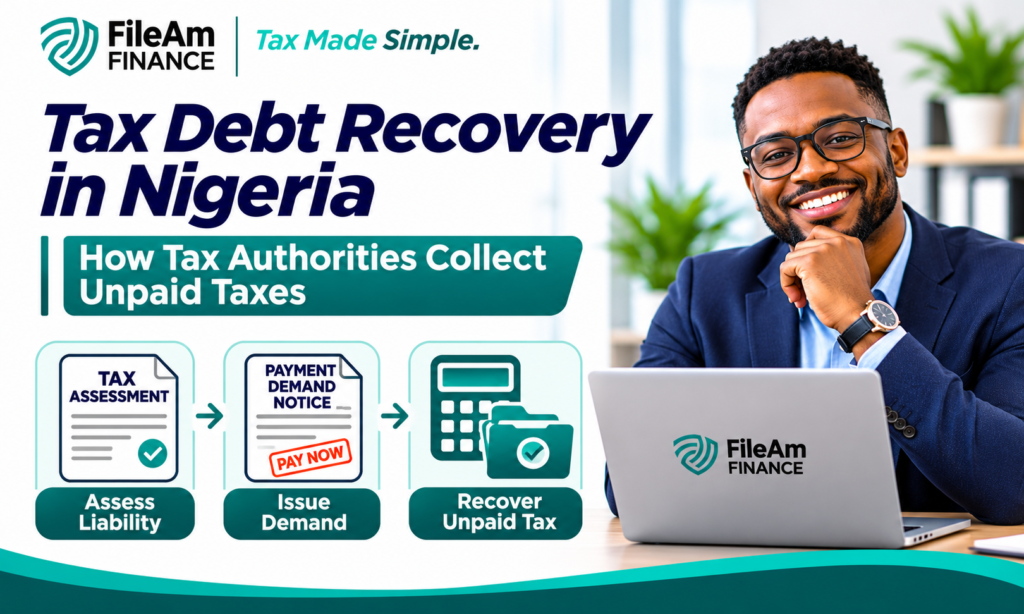
Paying taxes on time is an important part of staying compliant with Nigerian tax laws. However, individuals and businesses can sometimes accumulate unpaid tax liabilities because of missed filing deadlines, incorrect tax calculations, cash-flow difficulties, disputes over assessments, or simple administrative errors. When a tax liability remains unpaid, it can become a tax debt, and the relevant tax authority has legal mechanisms for recovering the amount owed.
Understanding tax debt recovery is therefore important for taxpayers who want to avoid escalating penalties, interest, enforcement action and potential disruption to their business operations.
Nigeria’s tax administration framework has undergone significant changes. The Nigeria Tax Administration Act, 2025 (NTAA) provides rules governing tax assessment, payment, collection and recovery, while the Nigeria Revenue Service (NRS) is the federal tax authority under the current framework. The Act came into effect alongside the broader 2025 tax reforms from 1 January 2026.
This article explains what tax debt recovery means, how unpaid taxes arise, the steps tax authorities can take to recover them and what taxpayers can do when they have outstanding tax liabilities.
What Is Tax Debt Recovery?
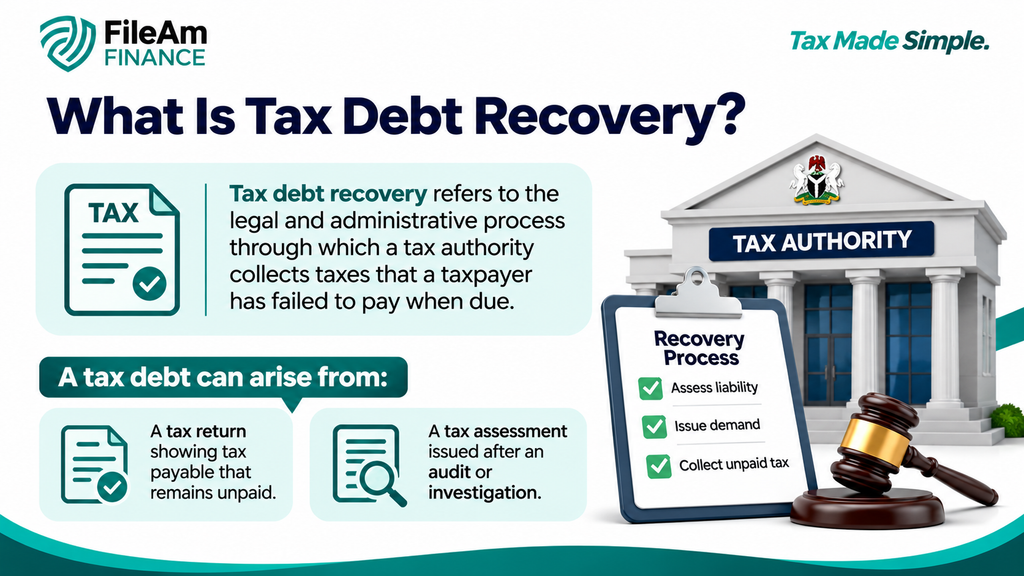
Tax debt recovery refers to the legal and administrative process through which a tax authority collects taxes that a taxpayer has failed to pay when due.
A tax debt can arise from different circumstances. For example, a taxpayer may file a return showing that tax is payable but fail to make the payment. A tax authority may also issue an assessment after an audit or investigation, creating an amount that becomes payable.
Under the Nigeria Tax Administration Act, tax that is due constitutes a debt owed to the relevant tax authority. Where the amount remains unpaid, the authority can use the recovery mechanisms provided by the law.
Tax debt recovery is therefore different from ordinary tax payment. Ordinary tax payment occurs when a taxpayer voluntarily settles an obligation by its due date. Recovery generally becomes relevant when the taxpayer has failed to settle a tax liability after it has become due.
How Does Tax Debt Arise in Nigeria?
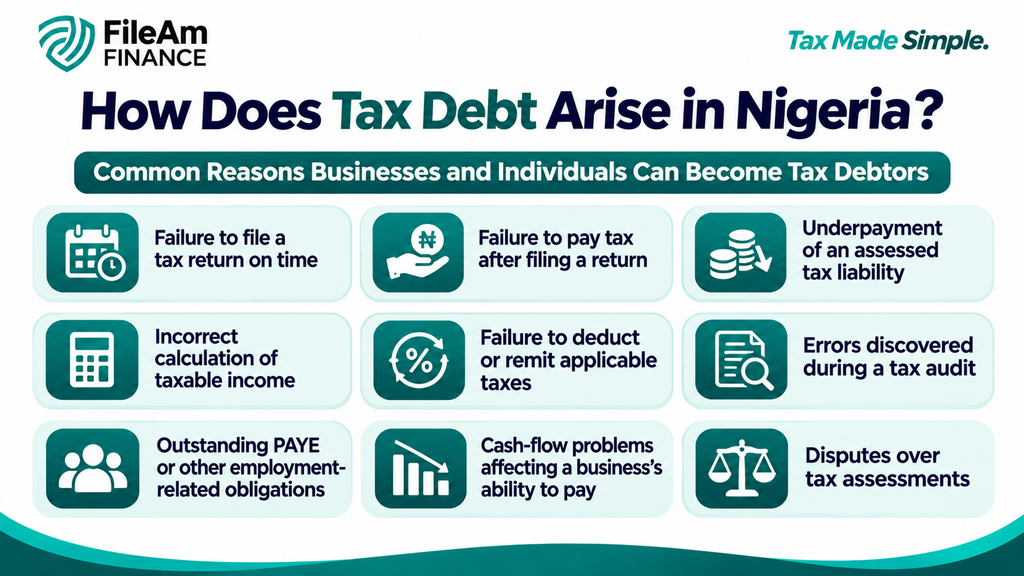
Tax debt does not necessarily result from deliberate tax evasion. Businesses and individuals can become tax debtors for several reasons.
Common causes include:
- Failure to file a tax return on time
- Failure to pay tax after filing a return
- Underpayment of an assessed tax liability
- Incorrect calculation of taxable income
- Failure to deduct or remit applicable taxes
- Errors discovered during a tax audit
- Outstanding PAYE or other employment-related obligations
- Cash-flow problems affecting a business’s ability to pay
- Disputes over tax assessments
- Accumulated penalties and interest
For businesses, tax debt can become particularly complicated when several tax periods are outstanding. A company may have unpaid liabilities from previous accounting periods while continuing to generate new tax obligations.
This is why businesses should monitor their tax balances rather than waiting for a demand notice before investigating whether they have outstanding liabilities.
When Does Tax Debt Become Subject to Recovery?
The process generally begins after a tax obligation becomes due and remains unpaid.
Under section 49 of the Nigeria Tax Administration Act, tax charged by an assessment that is not subject to an objection or appeal is generally payable within 30 days after service of the assessment notice, although the relevant tax authority may extend the payment period. Where tax remains unpaid after the due date, interest and penalties can apply.
The Act also provides that where there is no objection or appeal, the relevant tax authority may proceed to enforce recovery of the tax payable.
This makes it important for taxpayers to distinguish between a genuine tax dispute and an undisputed outstanding liability. Ignoring an assessment does not necessarily make the liability disappear.
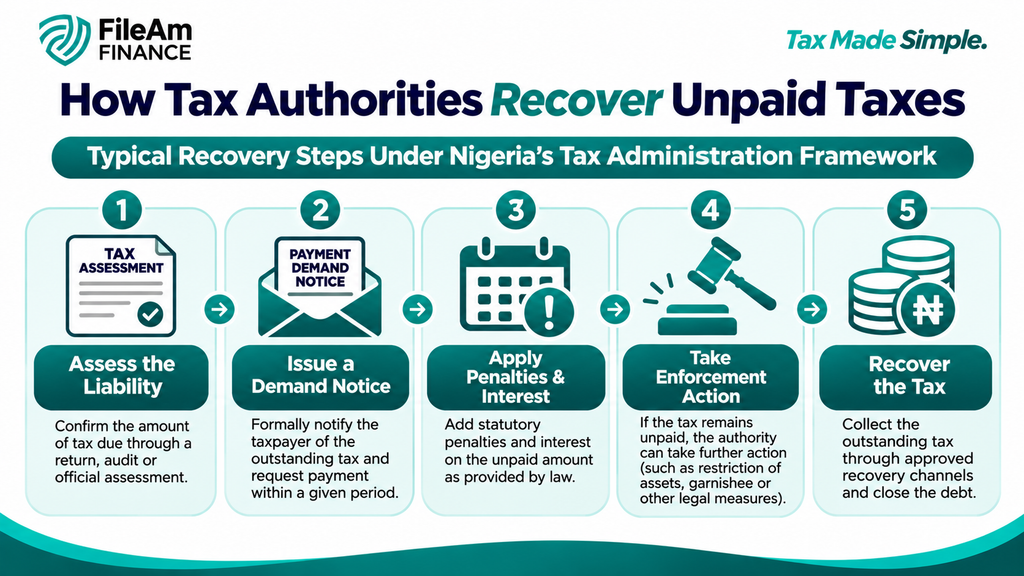
How Tax Authorities Recover Unpaid Taxes
Tax debt recovery can involve several stages. The exact approach depends on the circumstances, the type of tax involved and the applicable authority.
1. Assessment of the Tax Liability
Before recovery can take place, there must generally be an identifiable tax liability.
A taxpayer may determine the amount through self-assessment, or the relevant tax authority may determine an amount following an audit, investigation or other assessment process.
The taxpayer should carefully review the assessment to establish:
- The tax period involved
- The type of tax
- The principal amount
- Any applicable penalties
- Interest charged
- The payment deadline
- Whether there is a valid basis for objection or appeal
Keeping accurate records can help taxpayers identify whether an assessment is correct and whether previous payments have been properly credited.
2. Payment Demand
If the tax remains unpaid, the tax authority can move toward formal recovery.
Section 67 of the Nigeria Tax Administration Act provides that where tax due is not paid within 30 days, the relevant tax authority may issue a demand notice for payment of the tax together with applicable penalty and interest. If the amount remains unpaid after the date specified in the notice, the authority may exercise its recovery powers, including taking legal action.
A demand notice should therefore not be treated as ordinary correspondence that can simply be ignored.
For a taxpayer, receiving a demand notice is an opportunity to verify the liability and resolve the matter before more aggressive recovery measures become necessary.
3. Application of Interest and Penalties
Unpaid tax can become more expensive over time.
The Nigeria Tax Administration Act provides for penalties and interest on unpaid tax. Consequently, delaying payment can increase the amount ultimately required to settle the liability.
For businesses already dealing with cash-flow challenges, this can create a cycle in which an initially manageable tax obligation becomes significantly more difficult to settle.
Taxpayers should therefore calculate their total outstanding liability rather than focusing only on the original tax amount.
4. Recovery Through Legal Action
Where a taxpayer does not settle an outstanding liability following the applicable notices and recovery steps, the tax authority may pursue recovery through legal proceedings.
The law expressly recognises tax due as a debt owed to the relevant tax authority and permits legal action to recover unpaid amounts.
Legal recovery can have additional financial and operational consequences, making early engagement with the tax authority preferable where a taxpayer has a genuine outstanding liability.
5. Seizure of Assets Through Distress
One of the more serious forms of tax debt recovery is the use of distress against a taxpayer’s property.
Section 61 of the Nigeria Tax Administration Act provides a framework for recovery by distress. The statutory warrant of distraint can authorise recovery against certain goods, chattels, land, premises or other distrainable property for specified tax arrears.
This means that ignoring a tax debt can eventually expose business assets to enforcement action. For a business, such action could interfere with normal operations, particularly if assets essential to the business are affected.
Can Tax Debts Be Recovered Through Third Parties?
Yes. One of the notable features of the current tax administration framework is the provision for assignment of tax debts.
Under section 68 of the Nigeria Tax Administration Act, the relevant tax authority may assign outstanding tax debts, in whole or in part, to an accredited third party. However, the law sets conditions, including that the relevant legal steps for tax debt recovery such as notifications, payment demands and enforcement actions, must have been exhausted and that the debt must meet the applicable criteria for assignment.
The Act defines third parties to include banks and other financial institutions, debt recovery practitioners and other persons accredited by the relevant tax authority. A taxpayer whose debt is assigned must be notified in writing of the third party responsible for recovery.
This makes accurate tax recordkeeping and prompt response to recovery notices increasingly important for taxpayers.
What Should You Do If You Have Tax Debt?
Discovering an outstanding tax liability does not necessarily mean that enforcement action is inevitable. Taxpayers should act quickly.
Review the Tax Debt
Start by determining exactly what is outstanding. Check the relevant tax type, tax period, principal liability, interest and penalties.
Businesses should reconcile their accounting records with their tax records to identify discrepancies.
Confirm That the Assessment Is Correct
If you believe an assessment is incorrect, examine the applicable objection or appeal procedures and deadlines.
The Nigeria Tax Administration Act provides for circumstances in which collection may remain in abeyance where an objection or appeal has been properly made, subject to the conditions of the law. Tax that is not under objection or appeal may still need to be paid.
Because tax disputes can be technical, professional tax or legal advice may be appropriate for significant liabilities.
Pay What You Can, Where Appropriate
If the liability is valid and funds are available, settling the debt promptly can prevent further accumulation of applicable interest and penalties.
Taxpayers should use the official payment channels of the relevant tax authority and retain evidence of payment.
The NRS taxpayer self-service platform provides features for managing tax obligations, payments, assessments and tax balances.
Communicate With the Tax Authority
Silence can make a tax problem more difficult to resolve.
If a taxpayer is unable to pay immediately, it may be better to communicate with the relevant tax authority and understand what options are available rather than simply ignoring notices.
Any proposed payment arrangement should be confirmed through the appropriate official process and documented properly.
How Businesses Can Prevent Tax Debt
The best tax debt recovery strategy is prevention. Businesses can reduce the risk of accumulating unpaid taxes by building tax compliance into their normal financial processes.
Useful measures include:
Maintain accurate financial records.
Good bookkeeping makes it easier to calculate tax correctly and identify liabilities before deadlines expire.
Create a tax calendar.
Businesses should track filing and payment deadlines for each applicable tax.
Reconcile tax accounts regularly.
Regular reconciliation can reveal unpaid balances, duplicate payments or discrepancies before they become larger problems.
Automate tax calculations and reminders.
Tax compliance software can help businesses monitor obligations, deadlines, documents and outstanding balances.
Separate tax liabilities from operating cash.
Where possible, businesses should plan for tax payments instead of treating tax liabilities as available working capital.
Review assessments promptly.
If a tax authority issues an assessment, the business should review it quickly rather than allowing the response deadline to pass.
Why Tax Debt Management Matters
Tax debt is not simply an accounting issue. Persistent unpaid liabilities can affect a company’s financial planning, compliance position and relationship with tax authorities.
As unpaid liabilities accumulate, penalties and interest may increase the amount owed. Enforcement measures can also become more serious if the taxpayer fails to respond.
Effective tax debt management therefore involves identifying liabilities early, verifying their accuracy, paying valid debts promptly and responding appropriately when there is a genuine dispute.
For larger organisations, integrating tax debt monitoring into the company’s broader tax compliance process can provide greater visibility. Finance teams can use dashboards, automated alerts and digital records to identify overdue liabilities before they escalate.
Final Thoughts
Tax debt recovery in Nigeria is governed by a legal framework that gives tax authorities several mechanisms for collecting unpaid liabilities. Under the Nigeria Tax Administration Act, tax that is due constitutes a debt to the relevant tax authority, and unpaid liabilities can lead to demand notices, penalties and interest, legal recovery and, where applicable, enforcement against property or assignment of significant outstanding debts to accredited third parties.
For taxpayers, the most effective approach is not to wait until enforcement begins. Businesses and individuals should monitor their tax obligations, maintain accurate records, review assessments promptly and address outstanding liabilities as early as possible.
For businesses managing multiple tax obligations, tax compliance software can also help centralise tax records, monitor deadlines and identify outstanding obligations. This can make it easier to address potential tax debts before they develop into more serious compliance problems.
Note: Tax rules and administrative procedures can change, and the treatment of a particular tax debt depends on the taxpayer, tax type and applicable law. Taxpayers dealing with significant or disputed liabilities should obtain advice from a qualified Nigerian tax professional and confirm current requirements with the relevant tax authority.