How Businesses Can Simplify Certificate Processing Through a Tax Certificate Management System
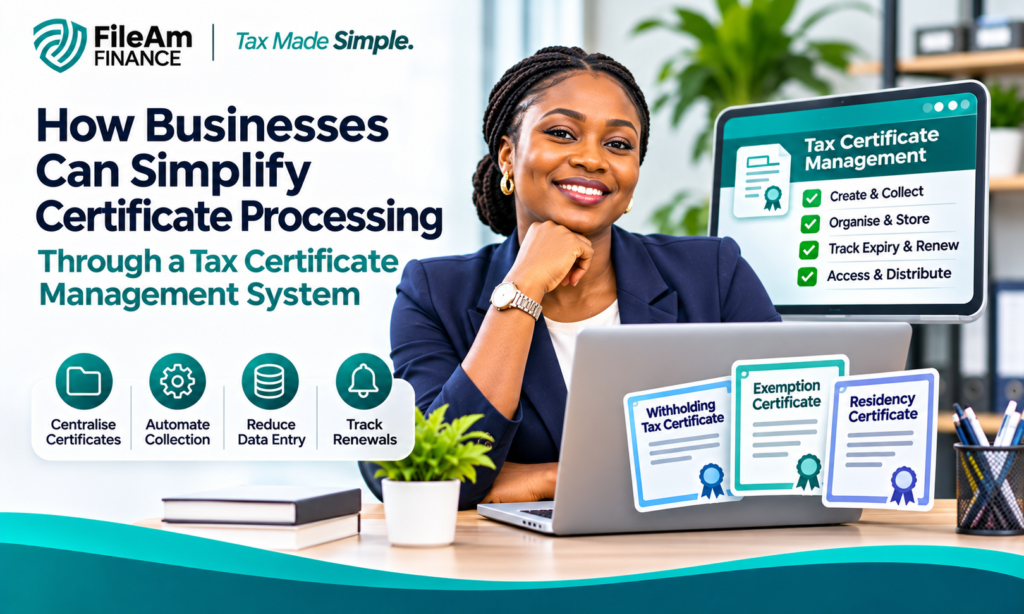
Having a solid tax certificate management system is essential for businesses of all sizes. Whether an organisation handles withholding tax certificates, exemption certificates, residency certificates, sales tax documentation, or other tax-related records, the process can quickly become complicated when it relies on spreadsheets, emails, paper files, and manual data entry.
As businesses grow, the number of certificates they need to create, collect, verify, store, renew, and distribute also increases. Without an organised system, tax teams can spend significant amounts of time searching for documents, checking certificate information, responding to requests, and monitoring expiration dates.
A tax certificate management system provides a structured way to simplify these activities. By centralising certificate information and automating repetitive processes, businesses can reduce administrative work, improve document visibility, and create a more consistent approach to tax certificate management.
Understanding Tax Certificate Management
Tax certificate management involves the processes used to create, receive, organise, validate, distribute, and maintain tax-related certificates and supporting documents.
For many organisations, these activities are handled across multiple departments. Finance teams may maintain tax records, procurement departments may collect certificates from suppliers, human resources may handle employee-related tax documentation, and compliance teams may monitor regulatory requirements.
When information is spread across different systems, maintaining accurate records becomes difficult. Employees may save documents using different naming conventions, store files in different folders, or maintain separate spreadsheets to track certificate status.
A tax certificate management system brings these processes together in one centralised environment. Instead of relying on disconnected tools, businesses can use a dedicated platform to manage certificates throughout their lifecycle.
1. Centralise All Tax Certificates
One of the biggest challenges associated with certificate processing is document organisation.
Businesses may have hundreds or thousands of certificates stored across computers, cloud folders, email accounts, shared drives, and physical filing cabinets. Finding a particular certificate can therefore take considerable time.
A tax certificate management system creates a central repository where authorised users can store and access relevant documents. Certificates can be organised according to useful information such as supplier, customer, employee, tax type, jurisdiction, issue date, or expiration date.
Centralisation makes information easier to locate and reduces the risk of important documents becoming lost or overlooked.
Instead of asking different departments to search their individual records, authorised employees can access the appropriate certificate from one location.
2. Automate Certificate Collection
Collecting certificates manually can be one of the most time-consuming parts of tax administration.
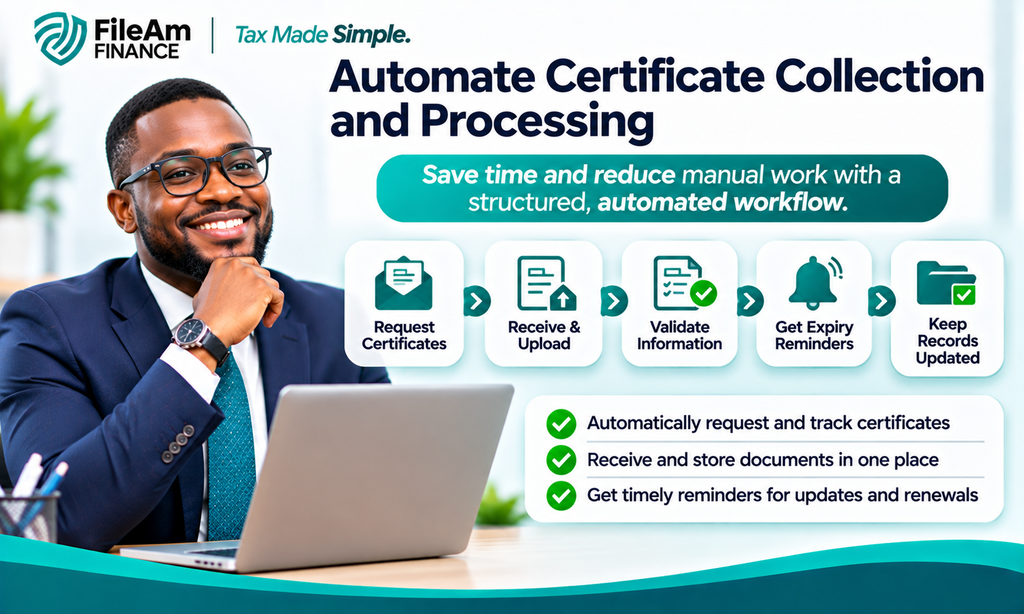
For example, a company may need to request certificates from hundreds of suppliers. Employees may have to send individual emails, follow up with organisations that have not responded, download attachments, rename files, and upload the documents into internal systems.
A tax certificate management system can help automate much of this workflow.
Businesses can establish standardised processes for requesting certificates and tracking outstanding documentation. Automated notifications can also remind recipients when documents are required or when previously submitted certificates need to be updated.
This allows tax and finance teams to spend less time performing repetitive administrative tasks and more time focusing on higher-value responsibilities.
3. Reduce Manual Data Entry
Manual data entry creates another significant challenge.
When employees receive a tax certificate, they may need to enter information such as names, identification numbers, tax classifications, effective dates, and expiration dates into spreadsheets or databases.
Every manual entry creates an opportunity for errors. A single incorrect digit or date can result in inaccurate records and additional work.
A modern tax certificate management system can reduce unnecessary manual entry by capturing and organising certificate information digitally. Depending on the capabilities of the platform, information may also be extracted from uploaded documents and used to populate relevant fields.
Reducing manual data entry can improve efficiency while helping businesses maintain more consistent records.
4. Monitor Certificate Expiration Dates
Tax certificates are not always valid indefinitely. Some documents have specific expiration dates or require periodic renewal.
Missing an expiration date can create compliance and operational problems. A business may continue relying on an outdated certificate without realising that updated documentation is required.
With a tax certificate management system, businesses can track certificate validity periods more effectively.
The system can provide notifications before certificates expire, giving employees enough time to contact the relevant party and request updated documentation.
For organisations managing a large number of certificates, automated expiration tracking can be particularly valuable. Instead of maintaining separate reminder spreadsheets or relying on employees’ calendars, certificate deadlines can be monitored within the same platform used to manage the documents.
5. Improve Document Verification
Collecting a certificate is only one part of the process. Businesses must also determine whether the information provided is complete and accurate.
Manual verification can become difficult when employees are processing large volumes of documents. Different team members may also follow different procedures, creating inconsistencies.
A tax certificate management system can help establish standardised verification workflows. Businesses can define the information that should be reviewed and create consistent procedures for approving, rejecting, or requesting additional documentation.
This creates greater consistency across the certificate management process.
Where applicable, businesses can also use system rules to identify missing information, incorrect formats, expired documents, or other issues that require attention.
6. Make Certificate Retrieval Faster
Tax departments frequently need to retrieve historical documents.
A supplier may request confirmation of a certificate. An internal auditor may need supporting documentation. A finance employee may need to investigate a previous transaction. A regulatory review may require access to historical records.
When documents are stored manually, locating the right file can take considerable time.
A tax certificate management system can make retrieval significantly easier through searchable records and structured document storage.
Instead of searching through email conversations or multiple folders, users can search for a certificate using relevant information and quickly access the associated document.
Faster retrieval can improve productivity and make responses to internal and external requests more efficient.
7. Strengthen Compliance and Record-Keeping
Effective record-keeping is an important part of tax administration. Businesses need to demonstrate that relevant documentation has been collected, maintained, and managed appropriately.
A centralised tax certificate management system can support better record-keeping by providing a structured environment for tax documentation.
Businesses can maintain records of certificates, track changes, and establish access controls for sensitive information. Depending on the system, activity logs may also provide visibility into actions performed on documents.
This can help organisations create a clearer audit trail and establish greater accountability around certificate processing.
The system does not replace professional tax or legal advice, but it can provide the organisational infrastructure needed to manage documentation more effectively.
8. Improve Collaboration Between Departments
Tax certificate processing rarely belongs to one department alone.
Finance teams may need information from procurement. Procurement may need documentation from suppliers. Compliance teams may need access to records maintained by finance. Managers may require reports showing outstanding or expired certificates.
When information is distributed across separate systems, collaboration becomes harder.
A tax certificate management system provides a shared environment where authorised users can access relevant information according to their responsibilities.
This can reduce unnecessary email exchanges and make it easier for teams to understand the current status of certificate requests.
For organisations with multiple offices or remote employees, centralised digital access can also make certificate management more practical.
9. Create Standardised Workflows
Different employees may manage certificates in different ways when there is no defined process.
One employee may save certificates using one naming convention, while another may use a completely different approach. Some may record expiration dates, while others may forget to do so.
Standardisation is therefore an important benefit of implementing a tax certificate management system.
Businesses can establish consistent workflows covering certificate requests, submissions, verification, approval, renewal, storage, and archiving.
A standardised process reduces uncertainty and makes it easier to train new employees. It also creates clearer accountability because team members can understand who is responsible for each stage of the process.
10. Generate Useful Reports
Businesses need visibility into their certificate management activities.
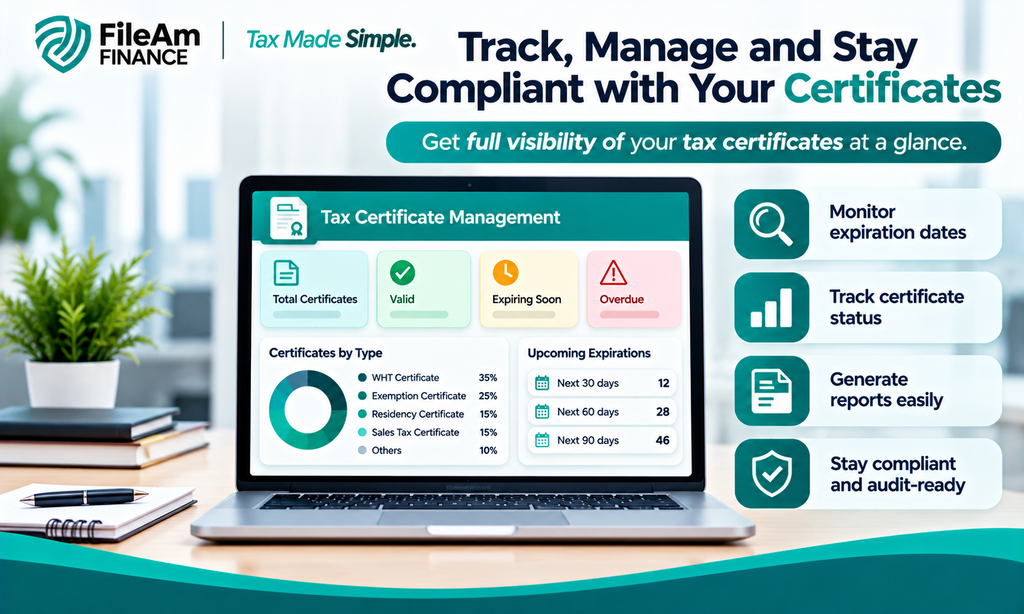
Managers may want to know how many certificates are current, how many are approaching expiration, which suppliers have outstanding documents, and where additional action is required.
Generating these reports manually can take time and may result in outdated information.
A tax certificate management system can provide reporting capabilities that give businesses a clearer view of their certificate portfolio.
With appropriate dashboards and reports, teams can identify outstanding tasks, monitor certificate status, and prioritise actions that require immediate attention.
This transforms certificate management from a largely reactive activity into a more organised and proactive process.
11. Reduce Administrative Costs
Manual certificate processing consumes employee time.
Employees may spend hours sending reminders, entering data, locating documents, updating spreadsheets, and responding to certificate-related requests.
While each task may appear small, the combined administrative burden can become substantial, particularly for large organisations.
Automation and centralisation can reduce the amount of repetitive work required. Employees can spend less time managing documents manually and more time performing analytical, strategic, and compliance-related responsibilities.
Over time, these efficiency improvements can contribute to lower administrative costs and better use of internal resources.
12. Make the Business More Scalable
Certificate management requirements generally increase as businesses expand.
A company that manages a few dozen certificates may be able to handle them with spreadsheets. However, the same approach can become increasingly difficult when the organisation works with thousands of suppliers, operates across multiple jurisdictions, or processes large volumes of tax documentation.
A tax certificate management system provides a more scalable approach.
Rather than continually adding spreadsheets and manual processes, businesses can build a structured certificate management environment that can accommodate increasing volumes of information.
This makes the system particularly useful for growing organisations that want their administrative processes to keep pace with business expansion.
Implementing a Tax Certificate Management System Successfully
Technology alone does not guarantee an efficient certificate management process. Businesses should also establish clear procedures around how the system will be used.
The first step is to review the existing certificate process and identify areas where delays, errors, or unnecessary manual work occur.
Next, the organisation should determine which certificate types need to be managed and identify the employees or departments responsible for each stage.
Businesses should also establish clear rules for document naming, verification, approval, retention, renewal, and access.
Employee training is another important consideration. Users should understand how to upload certificates, update records, respond to notifications, and complete assigned tasks.
Finally, organisations should regularly review the system and its workflows. As tax requirements and business operations change, certificate management processes may need to be updated.
The Future of Certificate Processing
Digital transformation is changing the way businesses manage administrative and compliance-related activities. Certificate processing is no exception.
As automation, artificial intelligence, document recognition, workflow management, and analytics technologies continue to develop, businesses can expect certificate management processes to become increasingly digital and automated.
The objective is not simply to replace paper documents with electronic files. The larger opportunity is to create an end-to-end process in which certificates can be requested, received, verified, organised, monitored, and renewed with less manual intervention.
For businesses managing significant volumes of tax documentation, this approach can create a more efficient and transparent operating model.
Conclusion
Tax certificate processing can become complicated when businesses rely on manual systems, disconnected spreadsheets, and scattered documents. As certificate volumes increase, these challenges can consume valuable employee time and make it harder to maintain accurate and accessible records.
A tax certificate management system provides a centralised approach to solving these challenges. By supporting certificate collection, document storage, verification, expiration tracking, reporting, and workflow automation, the system can simplify certificate processing while improving visibility and consistency.
For businesses looking to modernise their tax administration processes, implementing a tax certificate management system can be an important step toward creating a more organised, scalable, and efficient approach to certificate management.