Using Tax Filing Software To Find the Right Online Tax Filing Solution for Your Business
Tax filing should not require hours of spreadsheets, scattered documents, manual calculations, and last-minute stress.
Yet for many Nigerian businesses, that is still what tax compliance looks like. The right tax filing software can change that.
Instead of manually gathering financial information every time a tax deadline approaches, businesses can use digital tax software to organise records, calculate tax obligations, prepare returns, monitor compliance, and keep important documents in one place.
But with more businesses moving their financial processes online, choosing the best online tax filing solution requires more than finding a platform that allows you to submit a return.
You need software that can make tax compliance simpler, more accurate, more organised, and less time-consuming.
That is where FileAm comes in.
FileAm is built to help businesses manage tax compliance digitally, giving them a more organised way to move from financial records to tax filing.

Why Businesses Are Moving to Tax Filing Software
Tax compliance is becoming increasingly digital, but many businesses still manage their tax information through disconnected tools.
A typical business might use:
- Accounting software for financial records.
- Spreadsheets for tax calculations.
- Email for documents.
- Cloud storage for receipts.
- Bank statements for transaction verification.
- Separate portals for tax filing.
The problem is not necessarily that any one of these tools is inadequate. The problem is that the business owner has to connect them manually. That creates unnecessary work.
Tax filing software brings more of that workflow into one digital process.
Instead of asking, “Where did I save that document?” businesses can work from a structured system designed around tax compliance.
What Should the Best Tax Filing Software Do?
If you are searching for tax filing software, the most important question is not whether the software can file a return.
The better question is:
How much work will this software remove from my tax process?
The best solution should help with the stages before, during, and after filing.
1. Organise tax information
Your tax information should not be scattered across emails, spreadsheets, paper receipts, and different folders.
Good tax software gives you a structured place to manage relevant financial information.
2. Reduce manual calculations
Manual calculations create opportunities for errors.
Software can automate calculations based on the information entered into the platform, reducing repetitive work.
3. Make filing easier
A good platform should guide users through the information required for filing rather than leaving them to figure everything out themselves.
4. Keep records accessible
Tax compliance does not end after submission.
Businesses need access to historical information and supporting records when reviewing their finances or responding to future questions.
5. Track compliance
The best platforms help businesses understand what has been completed and what still needs attention.
6. Make tax understandable
Tax software should simplify complexity without hiding important information. Users should be able to understand what they are filing and why.
Why FileAm for Tax Filing?
FileAm is designed around a simple idea:
Tax compliance should be a manageable digital workflow, not a recurring administrative headache.
Instead of treating filing as an isolated event, FileAm gives businesses a way to organise their tax process more systematically. The platform can help businesses move through the compliance journey with greater visibility:
Organise → Calculate → Review → File → Keep Records
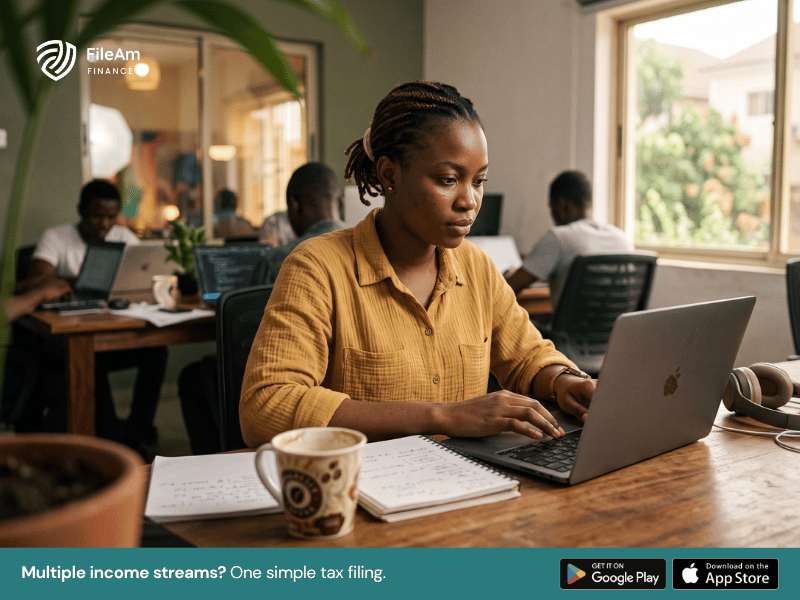
FileAm Helps You Stay Tax-Ready
One of the biggest problems with traditional tax filing is that businesses often prepare only when a deadline is approaching.
- By then, missing information can be difficult to find.
- A transaction may need to be reviewed.
- A document may be unavailable.
- Financial records may need to be reconciled.
- The business owner is suddenly under pressure.
FileAm’s SaaS approach provides an alternative. Instead of preparing for tax only when the deadline arrives, businesses can maintain a more organised tax workflow throughout the year.
That means fewer last-minute searches and less uncertainty.
Think of it as tax readiness rather than tax filing.
The difference is important. Tax filing is an event.
Tax readiness is an ongoing process.
Best Online Tax Filing: What Makes FileAm Different?
If you are comparing the best online tax filing platforms, look beyond whether each product has a “file” button.
The real differences are found in the experience surrounding that button.
Simplicity
Tax software should make the process easier, not give you another complicated system to learn.
FileAm is designed with a user-focused approach so businesses can manage their tax workflow without unnecessary complexity.
Organisation
Instead of relying on disconnected documents and spreadsheets, businesses can maintain a more structured digital tax process.
Visibility
A business should be able to understand its tax position and compliance status without searching through multiple systems.
Efficiency
Automating repetitive tasks can reduce the amount of administrative work required to prepare for tax filing.
Scalability
Your tax workflow should be able to grow with your business.
A platform that works for a small operation should ideally continue providing value as financial activity becomes more complex.
Tax Filing Software for Nigerian Businesses
Nigeria’s changing tax environment makes staying organised increasingly important.
The Nigeria Tax Act 2025 introduced significant changes to the tax framework from 2026, meaning businesses need to pay attention not only to filing deadlines but also to applicable rules and obligations.
This makes relying entirely on old spreadsheets or manually maintained templates increasingly risky.
Tax software can help businesses build a more consistent process for managing their tax information.
However, software should complement, not replace, appropriate professional tax or accounting advice where a business’s circumstances require it.
The objective is to reduce administrative friction while giving businesses better visibility over their compliance process.
Stop Building Your Tax Process Around Spreadsheets
Spreadsheets are useful, they are also easy to break. One incorrect formula, duplicated transaction, deleted row, or outdated tax assumption can affect the final calculation.
The larger the business becomes, the more difficult spreadsheet-based tax management can become.
Consider the difference:
Traditional process
Find documents → update spreadsheet → calculate tax → check formulas → correct errors → prepare return → search for supporting records → file → save documents.
Digital workflow
Organise financial information → review tax position → prepare filing → submit → maintain records.
The second approach does not eliminate the need for responsible financial management.
It eliminates unnecessary administrative friction.
Who Should Use Tax Filing Software?
FileAm as a tax filing software can be particularly useful for:
Small businesses
Small businesses often do not have dedicated tax departments. A digital platform can help reduce the administrative burden on owners and finance teams.
Growing companies
As transaction volume increases, manually managing tax information becomes increasingly difficult.
Freelancers and independent professionals
Multiple clients and income sources can make tax records difficult to maintain without a structured system.
Finance teams
Finance professionals can benefit from having a consistent digital workflow for preparing and maintaining tax information.
Businesses looking for better compliance visibility
If you want to know what has been completed, what still needs attention, and where your tax information is stored, a dedicated platform can provide greater visibility.
When Should You Switch to Tax Filing Software?
You do not have to wait until your current tax process becomes completely unmanageable. There are several signs that it is time to move to dedicated tax filing software.
- You spend too much time preparing returns.
If tax preparation repeatedly consumes hours that could be spent running your business, automation may provide a meaningful benefit.
- Your records are spread across multiple locations.
If your tax information lives in spreadsheets, email attachments, paper files, and different cloud folders, centralising the workflow can make compliance easier.
- You regularly file close to the deadline.
A more structured system can help reduce last-minute preparation.
- Your business is growing.
More revenue and more transactions usually mean more financial information to manage.
- You are worried about manual errors.
Software can reduce repetitive calculations and administrative mistakes.
- You want a repeatable process.
A business should not have to reinvent its tax preparation process every year.
What Does a Good Tax Filing Workflow Look Like?
A strong digital tax workflow should feel predictable. The following steps are advised:
Step 1: Organise
Bring relevant financial information into an organised workflow.
Step 2: Review
Check that the information required for filing is complete and accurate.
Step 3: Calculate
Use the appropriate tax rules and information to determine the tax position.
Step 4: Prepare
Get the necessary information and documentation ready for filing.
Step 5: File
Complete the relevant filing process.
Step 6: Store
Maintain records so the business can easily access its filing history and supporting information.
FileAm’s value lies in helping turn these individual tasks into a more connected experience.
Why Businesses Choose SaaS for Tax Compliance
Traditional software often creates another problem: maintenance.
Tax rules change.
Forms change.
Processes change.
A desktop application can become outdated unless it is regularly updated.
A SaaS model is better suited to an environment where users expect software to evolve continuously.
With a cloud-based tax platform, the experience can be updated centrally as the product and applicable processes evolve.
For businesses, that means less dependence on manually maintained templates and outdated spreadsheets.
It also means the tax workflow can become part of the company’s broader digital infrastructure.
Tax Filing Software Is an Investment in Time
The cost of tax software should not be evaluated only against the price of the subscription.
Consider the time your business currently spends on:
- Collecting documents.
- Updating spreadsheets.
- Rechecking calculations.
- Searching for records.
- Preparing returns.
- Tracking deadlines.
- Correcting mistakes.
That time has a cost.
If software reduces the amount of repetitive work required, the business is not simply buying a tax product. It is buying back administrative time.
For a business owner, that can mean more time spent on customers, sales, operations, employees, and growth. For a finance team, it can mean more time available for analysis instead of data entry.
FileAm vs. Manual Tax Filing
The choice is ultimately about workflow.
| Manual Tax Process | FileAm Approach |
|---|---|
| Information scattered across files | Structured digital workflow |
| Manual calculations | Software-assisted calculations |
| Deadline-driven preparation | Ongoing tax readiness |
| Repeated data entry | Reduced administrative work |
| Difficult record retrieval | Organised digital records |
| Reactive compliance | More proactive management |
The goal is not to make tax complicated with another piece of software. The goal is to remove unnecessary complexity.
The Best Online Tax Filing Option for Your Business
There is no universal “best” tax platform for every organisation.
The right choice depends on your business size, tax requirements, financial workflow, and level of automation needed.
But if your priority is moving away from fragmented tax administration toward a more organised SaaS workflow, FileAm is built around that problem.
The platform is particularly relevant for businesses that want to:
- Spend less time on manual tax administration.
- Keep financial and tax information organised.
- Improve visibility over compliance.
- Reduce dependence on spreadsheets.
- Create a repeatable filing process.
- Stay prepared throughout the year.
That is a much stronger proposition than simply providing an electronic tax form.
Before Choosing Tax Filing Software, Ask These Questions
Before committing to any platform, ask:
Can it handle my business’s tax workflow?
Make sure the software is relevant to your business type and tax obligations.
Does it reduce manual work?
If you still have to perform most tasks manually, the software may not deliver enough value.
Can I access my records easily?
Tax documents should not disappear into a system you cannot navigate.
Is the software easy for my team to use?
Complex software can create a different type of administrative burden.
Does it help me stay organised throughout the year?
This is particularly important if you want to move beyond deadline-driven filing.
Is security taken seriously?
Tax information is sensitive financial information. Data protection should be a core consideration.
Will the platform continue to be useful as my business grows?
The best tax technology should support your business rather than become another system you outgrow.
Make Tax Compliance a Business Process, Not a Year-End Crisis
The biggest mistake businesses make with tax is treating it as an event.
A deadline appears, documents are gathered. Calculations are performed. A return is submitted, then everyone forgets about tax until the next deadline. That approach creates unnecessary pressure. A better approach is continuous tax readiness. Your financial information is organised, your tax position is easier to understand. Your records remain accessible. Your filing history is maintained. Your team knows what needs to happen next.
That is the direction FileAm‘s SaaS positioning can take tax compliance.
Conclusion
Choose a Tax Filing System That Works Beyond Filing Day. The search for tax filing software should not end with finding a platform that lets you submit a tax return online. Businesses need more than digital submission.
They need organisation, visibility, efficiency, record keeping, and a workflow that reduces the pressure surrounding tax compliance.
If you are searching for the best online tax filing solution, evaluate the entire experience, not just the filing function.
Ask how much manual work the software removes.
Ask how easily you can access your records.
Ask whether the platform helps you stay tax-ready throughout the year.
And ask whether it can grow with your business.
FileAm is built around that broader vision.
Rather than treating tax as a once-a-year obligation, FileAm helps businesses move toward a more organised digital tax management workflow.
Stop waiting for tax deadlines to become urgent. Start staying tax-ready with FileAm.
Ready to simplify your tax workflow? Explore FileAm and make tax compliance a more organised part of running your business.