Managing Multiple Tax Obligations: How Businesses Can Stay on Top of FIRS Filing Requirements

Tax compliance becomes more complicated as a business grows.
A small business may begin with only a few tax responsibilities. As it adds employees, customers, suppliers, new revenue streams, and more transactions, the number of tax obligations it needs to monitor can increase.
Company Income Tax, VAT, Withholding Tax, PAYE, and other applicable obligations may all require different calculations, records, and filing schedules.
The difficult part is not necessarily understanding each tax separately.
The difficult part is keeping everything accurate, timely, and connected.
That is why businesses need a structured approach to managing their FIRS filing requirements. Although “FIRS filing requirements” remains a common search term, federal tax administration in Nigeria has transitioned to the Nigeria Revenue Service (NRS) under the 2025 tax reforms. The NRS currently provides tax services covering Company Income Tax, VAT, Withholding Tax, and other federal obligations.
What Are FIRS Filing Requirements?
FIRS filing requirements broadly refer to the obligations taxpayers have to report their tax information to the federal tax authority.
Filing is more than submitting a form.
A business needs to know:
- which tax obligations apply to it
- what information needs to be reported
- how the relevant tax should be calculated
- when the return should be filed
- whether payment or remittance is required
- what documents should support the return
- how evidence of compliance should be maintained
For example, companies generally have annual self-assessment filing obligations. The Nigeria Tax Administration Act 2025 specifies information that may form part of a company’s return, including financial statements, tax and capital allowance computations, evidence of payment and an attestation by a principal officer.
The exact requirements vary according to the taxpayer and tax involved. That is why businesses should manage tax compliance as a process rather than simply waiting for individual deadlines.
Which Tax Obligations Might a Business Need to Manage?
There is no universal tax checklist that applies identically to every Nigerian business.
The obligations depend on factors such as business structure, employees, transactions, income and activities.
Company Income Tax
Companies generally need to manage corporate tax computations, annual returns and payment of applicable liabilities.
For companies subject to annual self-assessment, the return must contain the information prescribed by the applicable tax framework.
Value Added Tax
Businesses involved in taxable supplies may have recurring VAT filing and payment responsibilities.
This makes accurate sales, purchases, and transaction records important throughout the year.
Withholding Tax
Businesses making payments that fall within applicable WHT rules may have responsibilities involving deduction, filing, remittance, and documentation.
The NRS maintains Withholding Tax as one of its federal tax services.
PAYE
Employers also have payroll-related tax responsibilities involving employee income and deductions.
Other Applicable Obligations
Depending on the business, other federal or state obligations may apply.
The important point is that business growth can change a company’s compliance profile.
Hiring employees, adding new services, entering new markets or changing transaction patterns can all create new tax considerations.
Why Managing Multiple Tax Obligations Is Difficult
Consider a business that manages VAT in one spreadsheet, WHT in another, payroll in a separate system and annual corporate tax through another process.
The company may technically have all the information it needs. But the information is disconnected. That creates several problems.
Different Filing Frequencies
Not every tax follows the same filing cycle. Some obligations require recurring attention, while corporate tax reporting follows an annual cycle.
Different Calculation Rules
The calculation used for one tax cannot simply be applied to another.
Multiple Deadlines
The more obligations a business has, the easier it becomes to overlook one.
Different Supporting Records
A tax return may depend on financial statements, transaction records, invoices, payroll information, schedules or other supporting documents.
Growing Transaction Volumes
Manual processes that work for a small company can become inefficient when transaction volumes increase.
This is where a centralized tax-compliance system becomes valuable.

Build a Tax Compliance Calendar
A business should not rely on memory to manage tax obligations. Instead, create a centralized compliance calendar that tracks each responsibility.
The calendar can include:
| Item | What to monitor |
|---|---|
| Tax obligation | VAT, WHT, CIT, PAYE, etc. |
| Filing frequency | Monthly, annual, or otherwise applicable |
| Statutory deadline | Official due date |
| Internal deadline | Team preparation deadline |
| Responsible person | Staff member or department |
| Payment/remittance | Status of amount due |
| Filing status | Prepared, submitted or pending |
| Evidence | Confirmation or reference |
The internal deadline is particularly important.
If the official deadline is Friday, Friday should not be the day the finance team begins preparing the return. The Nigeria Revenue Service publishes filing and payment deadlines as part of its compliance resources, including a tax calendar for taxpayers.
A business should use those official deadlines to build its own earlier preparation schedule.
Tax Preparation Is Not the Same as Tax Filing
Another common mistake is treating tax compliance as a single activity. A stronger process separates it into stages:
Prepare → Calculate → Review → File → Pay/Remit → Record
Prepare
Gather financial information and supporting documents.
Calculate
Determine the applicable tax liability.
Review
Compare the tax information against accounting records and supporting evidence.
File
Submit the applicable return.
Pay or Remit
Complete the required payment or remittance.
Record
Retain the filing confirmation, payment evidence, and supporting documentation. This process can be applied across multiple tax obligations.
Keep Your Financial Information Consistent
Managing taxes separately does not mean the underlying financial information should be disconnected. Revenue reported in accounting records should make sense alongside the information used for applicable tax filings.
The same principle applies to:
- VAT transactions
- WHT deductions
- payroll records
- Company Income Tax calculations
- financial statements
Inconsistencies can create unnecessary questions during tax reviews. Digital tax administration makes this even more important because taxpayers can now access electronic services for filing, payments, assessments, tax clearance, and other compliance activities through the NRS ecosystem.
The better the underlying records, the easier it becomes to manage multiple obligations accurately.
What Happens If a Business Misses a Filing Requirement?
Missing a tax filing does not make the underlying obligation disappear. Depending on the tax involved and the circumstances, a business may face:
- late-filing penalties
- interest or other financial consequences
- additional administrative work
- requests for clarification
- compliance issues
- difficulties resolving historical records
The Nigeria Tax Administration Act 2025 provides the broader legal framework for returns, assessment, payment and enforcement.
The practical lesson is simple:
Preventing compliance problems is usually easier than fixing them after they occur.
How Technology Can Simplify Multiple Tax Obligations
Managing several taxes manually creates unnecessary administrative work. A modern tax platform can connect the different stages of compliance.
Technology can help businesses:
Centralize Tax Information
Keep relevant financial and tax information in one structured environment.
Calculate Tax
Reduce repetitive calculations and give businesses a clearer view of their tax position.
Prepare Returns
Organize financial information into tax-ready data.
File Digitally
Manage applicable tax submissions through electronic workflows.
Track Compliance
Monitor filing activities, deadlines and outstanding obligations.
Maintain Tax Records
Keep filing information, payment evidence and supporting documents accessible.
Get Tax Assistance
When a business encounters a tax question, an AI-powered tax assistant can provide immediate guidance on relevant tax concepts and processes.
This is where FileAm becomes particularly useful.
How FileAm Helps Businesses Manage Multiple Tax Obligations
FileAm is built as a comprehensive tax-compliance platform rather than a tool designed for only one tax or one filing activity. FileAm can help manage taxes by categorizing them by authority and frequency, creating a tax-only cash flow, using a tax calendar, and centralizing records and compliance checks.
Businesses can also use FileAm to manage applicable tax obligations across areas such as:
- Company Income Tax
- VAT
- Withholding Tax
- PAYE
- Other relevant tax obligations
The platform can support businesses across the broader compliance workflow:
Understand → Calculate → Prepare → File → Pay/Remit → Monitor
Instead of calculating tax in one place, preparing a return somewhere else, and keeping compliance records in disconnected systems, businesses can manage more of their tax activities within one digital environment.
FileAm can help businesses:
Calculate Tax Obligations
Use relevant financial information to determine applicable tax positions.
Prepare Tax Returns
Organize the information needed for applicable tax filings.
File Tax Returns
Manage applicable statutory tax submissions digitally.
Manage Compliance
Keep track of tax responsibilities instead of relying entirely on manual reminders.
Maintain Tax Information
Keep relevant financial and tax information organized for future reference.
For businesses with multiple obligations, this connected approach can make tax management considerably easier.
TaxGPT: Tax Assistance When Questions Come Up
Tax compliance is full of questions.
A finance manager might ask:
Does this payment attract WHT?
A business owner might ask:
Which tax return do I need to file?
An accountant might ask:
How should this tax position be calculated?
TaxGPT, FileAm’s AI-powered tax assistant, gives users a way to ask questions about Nigerian tax matters within the FileAm ecosystem.
Users can explore questions around:
- tax calculations
- filing requirements
- VAT
- Company Income Tax
- Withholding Tax
- PAYE
- personal taxation
- general Nigerian tax concepts
This means FileAm is not only helping with the administrative side of tax compliance.
It also gives users a way to understand the tax obligations they are managing.
For complex matters requiring professional judgment, businesses should still seek appropriate professional tax advice.
Managing Tax Compliance as Your Business Grows
The need for a structured tax system becomes more important as a company expands.
Small Businesses
Small businesses may not have dedicated tax departments. A centralized platform can reduce the administrative burden of managing tax responsibilities.
Growing SMEs
As transaction volumes, employees, and revenue increase, tax compliance becomes more complicated. A scalable system can help businesses maintain control as they grow.
Large Businesses
Larger companies may have several finance teams and multiple tax obligations. Centralized tax management can improve visibility and coordination.
Accountants and Finance Teams
Finance professionals need reliable information, clear workflows and efficient processes to prepare and manage tax filings.
The underlying principle is the same:
Your tax-management system should be capable of growing with your business.
Common Mistakes Businesses Make With FIRS Filing Requirements
Many tax compliance problems are caused by fragmented processes rather than deliberate non-compliance.
A business may:
- assume every company has the same tax obligations
- track deadlines manually
- prepare returns at the last minute
- use different financial figures across departments
- forget to reconcile tax records
- lose filing confirmations
- treat compliance as a once-a-year activity
These problems become increasingly difficult to manage as a business grows.
A centralized tax-compliance system can help reduce that fragmentation.
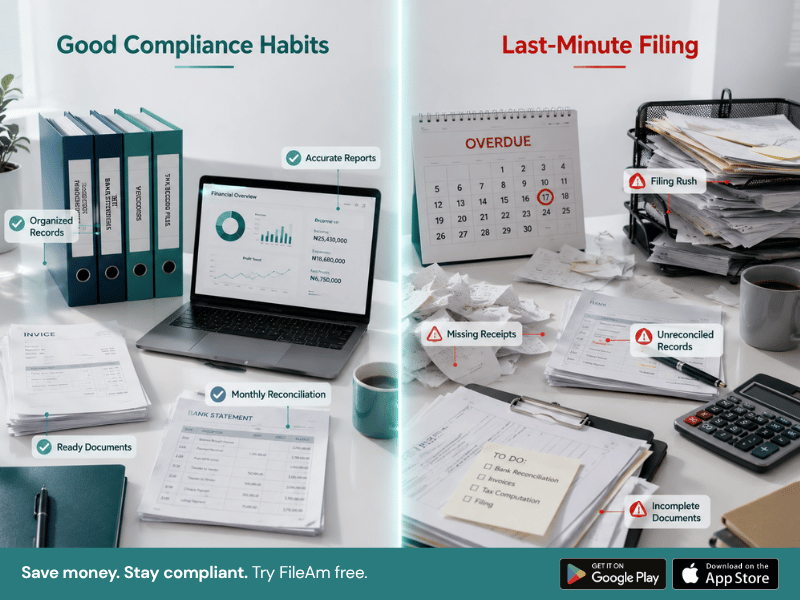
A Better Way to Manage Tax Compliance
A practical tax-management framework can be summarized as:
Know → Track → Calculate → Review → File → Pay/Remit → Record → Monitor
First, identify which obligations apply to the business.
Then track their deadlines.
Calculate the relevant tax positions using accurate financial information.
Review before submission. File the required returns and complete any associated payments or remittances. Keep the evidence.
Then continue monitoring compliance throughout the year.
This changes tax management from a series of emergencies into an ongoing business process.
Frequently Asked Questions
What are FIRS filing requirements?
FIRS filing requirements broadly refer to the returns, information, calculations and supporting documentation taxpayers must provide under applicable federal tax laws. Federal tax administration is now handled by the Nigeria Revenue Service, but “FIRS filing requirements” remains a widely used search term.
What taxes do businesses need to file?
It depends on the business. Common obligations can include Company Income Tax, VAT, Withholding Tax and PAYE-related responsibilities, alongside other obligations that may apply based on the company’s activities.
How often do businesses file tax returns?
The frequency depends on the tax. Some obligations require recurring filings, while others follow an annual cycle. Businesses should confirm the applicable requirements for each tax.
Are FIRS filing requirements the same for every business?
No. Tax responsibilities depend on factors such as business structure, activities, employees, transactions, and income.
What documents are required for tax filing?
The documents depend on the tax being filed. They may include financial statements, tax computations, invoices, transaction records, schedules, payment evidence, and other supporting information.
What happens if a business misses a filing deadline?
The business may face applicable penalties, interest or other compliance consequences. Promptly addressing the missed filing is generally better than allowing the issue to remain unresolved.
Can businesses file taxes online?
Yes. The NRS provides digital taxpayer services, including self-tax filing and payments through its taxpayer self-service platform.
Can FileAm manage multiple tax obligations?
Yes. FileAm is designed to support businesses in managing multiple applicable tax obligations, including tax calculation, return preparation, filing and broader compliance activities.
Can FileAm calculate and file taxes?
FileAm provides tax calculation and tax filing capabilities, allowing businesses to manage more of the tax process through one digital platform.
What is TaxGPT?
TaxGPT is FileAm’s AI-powered tax assistant. It helps users ask questions and obtain guidance about Nigerian tax matters, calculations, filing requirements, and compliance.
Can small businesses use FileAm?
Yes. FileAm supports businesses of different sizes as well as individuals with applicable tax needs.
Conclusion: Stop Managing Tax as a Collection of Separate Deadlines
Managing multiple tax obligations becomes difficult when every tax is treated as an isolated administrative task.
Businesses need to know what applies to them, when each obligation is due, what information is required, how the tax should be calculated, what needs to be filed, and whether the resulting payment or remittance has been completed.
That requires more than a calendar.
It requires a connected system.
FileAm brings tax calculation, tax filing, compliance management, and tax assistance into one platform, helping businesses move from fragmented tax administration to a more organized and connected compliance process.
And when questions arise, TaxGPT gives businesses and individuals an AI-powered way to understand Nigerian tax matters within the same ecosystem.
The goal is not simply to meet one filing requirement.
It is to build a tax-compliance process that can keep up with the business as it grows.