Withholding Tax Rates in Nigeria: Complete Guide

If your business pays a consultant ₦1 million, rents an office, hires a contractor, pays dividends, or purchases certain services from another business, the amount you transfer may not always be the amount that leaves your company’s books. The applicable withholding tax rates in Nigeria determine how much may need to be deducted at source before the balance is paid to the recipient.
The tricky part is that there is no single withholding tax rate that applies to every transaction.
The applicable rate can depend on:
- What the payment is for.
- Whether the recipient is an individual or a company.
- Whether the recipient is resident in Nigeria or non-resident.
- Whether a special rule or exemption applies.
- Whether a tax treaty affects a payment to a non-resident.
Nigeria’s current withholding tax framework therefore requires businesses to classify the transaction correctly before applying a percentage. The 2025 tax reforms consolidated the tax framework, while the relevant withholding rules and rates continue to govern deductions at source.
The Current Withholding Tax Rates at a Glance
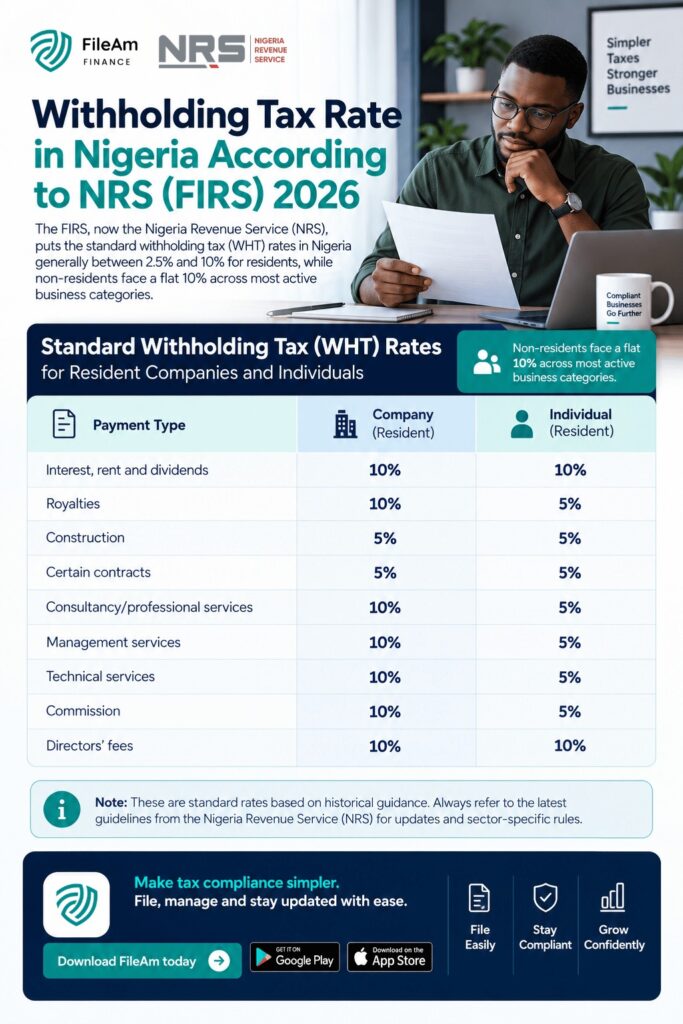
For businesses that simply want to know the applicable rate before processing a payment, the table below provides a practical starting point.
| Payment type | Resident company | Non-resident company | Resident individual | Non-resident individual |
|---|---|---|---|---|
| Dividends | 10% | 10% | 10% | 10% |
| Interest | 10% | 10% | 10% | 10% |
| Rent, hire or lease | 10% | 10% | 10% | 10% |
| Royalties | 10% | 10% | 5% | 5% |
| Consultancy/professional fees | 5% | 10% | 5% | 10% |
| Technical services | 5% | 10% | 5% | 10% |
| Management fees | 5% | 10% | 5% | 10% |
| Commission/brokerage | 5% | 10% | 5% | 10% |
| Other construction-related activities | 5% | 10% | 5% | 10% |
| Road, bridge, building and power-plant construction | 2% | 5% | 2% | 5% |
| Supply of goods/materials by someone other than the producer/manufacturer | 2% | — | 2% | — |
| Other specified services | 2% | 5% | 2% | 5% |
| Directors’ fees | N/A | N/A | 15% | 20% |
| Entertainers and sportspersons | N/A | 15% | N/A | 15% |
The table is a practical summary of the current rate structure. Certain transactions have specific conditions, exemptions, or special treatment, so businesses should verify the exact transaction against the applicable rules before deducting WHT.
Why Are There Different WHT Rates?
A common assumption is that withholding tax works like VAT: one transaction, one standard percentage.
It doesn’t.
The WHT system is transaction-based.
For example, imagine a company makes these payments during the same month:
- ₦2 million to a consultant.
- ₦3 million for office rent.
- ₦5 million to a contractor.
- ₦1 million in interest.
- ₦4 million to a supplier.
It would be a mistake to automatically apply the same percentage to all five payments.
The underlying transactions are different, so the applicable WHT treatment may also be different.
This is why classification comes before calculation.
Before applying a rate, the finance team should ask:
“What exactly are we paying for?”
Only then should it determine which WHT category applies.
Withholding Tax Rates for Professional and Consultancy Services
Professional, consultancy, technical, and management services generally attract a 5% rate for resident recipients and 10% for non-resident recipients under the current framework.
This category can cover payments relating to services such as:
- Consulting.
- Legal services.
- Accounting services.
- Engineering services.
- Technical services.
- Management services.
- Other qualifying professional services.
Example
A Nigerian company hires a resident consultant for ₦2,000,000.
If the payment is subject to WHT at 5%:
₦2,000,000 × 5% = ₦100,000
The company would deduct ₦100,000 and pay the consultant the applicable net amount, subject to VAT and other relevant considerations.
The deducted ₦100,000 is then dealt with through the applicable WHT remittance and documentation process.
If the same type of qualifying service is provided by a non-resident recipient, the applicable domestic rate may be 10%, although treaty provisions can affect the final treatment in eligible circumstances.
WHT Rate on Dividends and Interest
Dividends and interest generally attract a 10% withholding rate.
This applies across the main resident and non-resident categories in the current rate structure, subject to applicable rules and treaty provisions.
For example, if a company declares a ₦10 million dividend that is subject to WHT:
₦10,000,000 × 10% = ₦1,000,000
The WHT deduction would therefore be ₦1 million.
Interest payments can similarly attract WHT at 10%, although specific exemptions and special treatment can apply to certain transactions.
Businesses should therefore avoid applying the rate without first checking whether the particular payment falls within an exemption.
WHT Rate on Rent, Hire and Lease Payments
Rent, hire, and lease payments generally attract WHT at 10%.
This can cover qualifying payments relating to:
- Land.
- Buildings.
- Certain equipment.
- Other qualifying hire or lease arrangements.
For example, if a business makes a qualifying rent payment of ₦5 million:
₦5,000,000 × 10% = ₦500,000
The WHT would be ₦500,000, subject to the exact nature of the payment and applicable rules.
One important point is that WHT treatment should not be determined solely by calling something “rent” in an accounting system.
The underlying agreement and nature of the payment should be considered.
WHT Rates for Royalties
Royalties have different rates depending on the type of recipient.
The current rate structure provides:
- 10% for corporate recipients.
- 5% for non-corporate recipients.
This is a good example of why businesses should not rely on a single WHT percentage.
The payment category may be the same, but the recipient’s status can affect the rate.
WHT Rates for Construction
Construction-related payments require particular attention because the rate can depend on the specific type of construction activity.
For road, bridge, building, and power-plant construction, the current rate structure provides:
- 2% for resident recipients.
- 5% for non-resident recipients.
Other construction-related activities can attract higher rates depending on the transaction.
This means a business should not automatically apply 2% to every construction invoice.
For example, a construction company may invoice for a qualifying building project, while an architect may separately invoice for professional services connected with that project.
Those payments should not automatically be treated as the same type of transaction.
The nature of the actual service matters.
WHT on the Supply of Goods
Certain supplies of goods or materials can attract a 2% WHT rate where the supplier is not the producer or manufacturer, subject to the applicable rules.
This is particularly relevant for businesses that make regular purchases from vendors.
However, businesses should pay attention to the distinction between:
- Buying goods in the ordinary course of business.
- Buying goods from a manufacturer or producer.
- Other transactions that may be treated as contracts or services.
A procurement department should therefore work with the finance team rather than assuming that every supplier invoice receives identical tax treatment.
WHT on Directors’ Fees
Directors’ fees have their own treatment.
The current rate structure provides:
- 15% for resident individual directors.
- 20% for non-resident individual directors.
Companies should distinguish directors’ fees from ordinary employee salaries because the tax treatment is different.
PAYE and WHT are not interchangeable systems.
WHT Rates for Entertainers and Sportspersons
Payments to non-resident entertainers and sportspersons can attract a 15% WHT rate, with the withholding treated as final tax under the applicable framework.
This can become relevant to businesses involved in:
- Events.
- Entertainment.
- Sports.
- Advertising.
- Sponsorships.
- Media productions.
The source and nature of the income should be considered carefully when making such payments.
Resident vs Non-Resident WHT Rates
Residency is one of the biggest reasons the rate can change.
For some categories, a Nigerian resident recipient may attract a lower WHT rate than a non-resident recipient.
For example:
Professional/consultancy services
- Resident: 5%.
- Non-resident: 10%.
Certain construction activities
- Resident: 2%.
- Non-resident: 5%.
The higher non-resident rate can serve as a final tax in certain circumstances, particularly where the non-resident does not have a taxable presence in Nigeria.
Businesses making payments to foreign companies should therefore not simply copy the rate used for a Nigerian vendor.
How Double Taxation Agreements Can Affect WHT Rates
A Nigerian business paying a foreign company may encounter another layer of complexity: a Double Taxation Agreement (DTA).
Nigeria has tax treaties with several countries, and some treaties can limit the amount of tax Nigeria may impose on certain types of income.
For example, domestic Nigerian law may prescribe a 10% WHT rate for certain passive income paid to a non-resident, while an applicable treaty may provide a lower maximum rate.
In some treaty situations, rates of 7.5% can apply to qualifying dividends, interest, or royalties.
However, a treaty rate should not simply be applied because the recipient’s country has a DTA with Nigeria.
Businesses may need to consider:
- Whether the treaty applies.
- Whether the recipient qualifies.
- Whether the recipient is the beneficial owner.
- Whether the required documentation is available.
- Whether the income falls within the treaty provision.
- Whether the treaty has been properly invoked.
For cross-border payments, professional tax advice can be worthwhile.
What Happens If the Recipient Does Not Have the Required Tax Registration?
Tax registration and identification can affect WHT treatment.
The current framework contains rules that can result in a higher deduction where a recipient that should be registered does not provide the required tax identification information. Guidance on the 2024 WHT regulations notes that certain non-passive income may be subject to double the applicable rate where the recipient is not registered as required.
This is one reason businesses should collect and verify relevant tax identification information from vendors before processing qualifying payments.
It is much easier to resolve documentation issues during vendor onboarding than after a payment has already been made.
Are There Transactions That Are Exempt From WHT?
Yes.
WHT does not apply to every transaction that looks like a business payment.
The current framework contains exemptions for specified transactions, including certain:
- Compensating payments under registered securities-lending transactions.
- Qualifying distributions to Real Estate Investment Trusts or Real Estate Investment Companies.
- Certain across-the-counter transactions.
- Certain interest and fees paid to Nigerian banks through direct debit arrangements.
- Goods manufactured or materials produced by the person making the supply.
There can also be specific exemptions or reliefs applicable to particular taxpayers or transactions.
This is why the right question is not simply:
“What WHT rate do we use?”
It should be:
“Does WHT apply to this transaction, and if it does, what rate applies?”
That small change in thinking can prevent significant compliance errors.
How to Calculate Withholding Tax
Once the correct rate has been identified, the basic calculation is straightforward.
WHT = Qualifying Payment × Applicable WHT Rate
For example, suppose a Nigerian company owes a resident professional-services provider ₦4 million, and the applicable rate is 5%.
₦4,000,000 × 5% = ₦200,000
The WHT deduction is ₦200,000.
The net amount before considering other taxes or adjustments would be:
₦4,000,000 − ₦200,000 = ₦3,800,000
The calculation itself is easy.
The difficult part is identifying whether the payment is actually subject to WHT and selecting the correct rate.

Should VAT Be Included Before Calculating WHT?
Businesses should be careful when calculating WHT on invoices that also contain VAT.
The WHT calculation generally needs to be based on the relevant taxable payment rather than blindly applying the WHT percentage to every figure appearing on an invoice.
For example, an invoice might show:
- Service fee: ₦2,000,000.
- VAT: ₦150,000.
- Total invoice: ₦2,150,000.
The finance team should determine the correct WHT base under the applicable rules instead of simply multiplying ₦2,150,000 by the WHT rate.
Because the treatment can depend on the specific transaction and current rules, businesses should confirm the appropriate tax base before processing the deduction.
Is Withholding Tax the Final Tax?
Not always.
For many resident recipients, WHT operates as an advance payment or credit against their eventual income tax liability.
For some non-resident payments, however, WHT can operate as final tax under the applicable rules.
This distinction is important.
A company that receives ₦950,000 after ₦50,000 WHT has been deducted should not automatically record only ₦950,000 as its gross income.
The company should account for:
- The original income.
- The WHT deducted.
- The amount actually received.
- The WHT credit documentation.
The WHT may then be relevant when the recipient calculates its wider tax liability.
What Happens If the Wrong WHT Rate Is Used?
Using the wrong rate can create problems for both parties.
If Too Much WHT Is Deducted
The recipient may:
- Receive less cash than expected.
- Dispute the deduction.
- Need to reconcile the excess.
- Experience difficulty claiming the correct tax credit.
If Too Little WHT Is Deducted
The payer may face:
- Additional tax exposure.
- Interest.
- Penalties.
- Reconciliation problems.
- Tax authority queries.
This is why WHT should be reviewed before payment rather than treated as an accounting adjustment that can always be fixed later.
Common Mistakes When Applying WHT Rates
Applying One Rate to Every Payment
Different transaction categories have different rates.
Ignoring Recipient Residency
The resident/non-resident distinction can materially affect the rate.
Confusing Services With Goods
A supplier invoice may represent goods, services, construction, consultancy, or another category.
Using Old Rate Tables
Tax rules and administrative guidance can change.
Ignoring Exemptions
Not every qualifying-looking transaction is automatically subject to deduction.
Forgetting Treaty Rules
Cross-border transactions can require DTA analysis.
Calculating WHT Without Supporting Documents
The finance team should be able to explain why a particular rate was applied.
Failing to Issue Supporting Documentation
Recipients need evidence of WHT deductions for proper tax accounting and credit claims.
How Businesses Can Avoid WHT Rate Errors
A reliable WHT process should begin before the payment is approved.
A business can create a simple internal checklist:
- Confirm the supplier’s legal name.
- Obtain the relevant tax identification information.
- Review the contract.
- Identify what the payment is actually for.
- Determine whether WHT applies.
- Determine whether an exemption applies.
- Confirm the recipient’s residency.
- Verify the applicable rate.
- Calculate the deduction.
- Review the calculation.
- Process the payment.
- Remit the WHT within the applicable deadline.
- Issue the required documentation.
- Reconcile the transaction.
This process turns WHT from a last-minute calculation into part of the normal procurement and payment workflow.
How FileAm Can Help Businesses Manage WHT Records
Getting the rate right is only part of WHT compliance.
Businesses also need to maintain the documents supporting each deduction.
That can include:
- Vendor invoices.
- Contracts.
- Tax identification information.
- WHT schedules.
- WHT credit notes or certificates.
- Payment confirmations.
- Remittance evidence.
- Tax correspondence.
FileAm helps businesses centralize financial and compliance documents in a structured digital environment.
Instead of having WHT records scattered across email inboxes, spreadsheets, physical files, and different employee devices, businesses can organize the documentation needed to support their tax processes.
This can make it easier to:
- Retrieve WHT documents.
- Match deductions to invoices.
- Organize records by vendor or transaction.
- Prepare for tax filings.
- Respond to tax authority requests.
- Maintain audit-ready documentation.
For businesses making frequent payments, the ability to trace a WHT deduction back to the original invoice and supporting documents can save significant time.

Frequently Asked Questions About Withholding Tax Rates in Nigeria
What is the standard withholding tax rate in Nigeria?
There is no single standard rate for every transaction. Common rates include 5%, 10%, 2%, and other rates depending on the type of payment, recipient, residency, and applicable rules.
What is the WHT rate on professional fees?
For qualifying professional and consultancy fees, the rate is generally 5% for resident recipients and 10% for non-resident recipients.
What is the WHT rate on rent in Nigeria?
The general rate for qualifying rent, hire, or lease payments is 10%.
What is the WHT rate on dividends?
The general rate on dividends is 10%, subject to applicable rules and treaty provisions for qualifying cross-border transactions.
What is the WHT rate on interest?
Interest generally attracts WHT at 10%, subject to applicable exemptions and treaty provisions.
What is the WHT rate on royalties?
The rate can depend on the recipient. The current structure provides 10% for corporate recipients and 5% for non-corporate recipients.
What is the WHT rate for construction?
The rate depends on the specific construction activity. Road, bridge, building, and power-plant construction currently attract 2% for residents and 5% for non-residents, while other construction-related activities can attract higher rates.
Is WHT deducted from every invoice?
No. The business must first determine whether the transaction is one to which WHT applies and whether any exemption is available.
Can a WHT rate be lower under a tax treaty?
Yes. An applicable Double Taxation Agreement can limit the Nigerian withholding rate for certain qualifying payments to non-residents.
Does WHT mean the recipient’s tax has been fully paid?
Not necessarily. For many resident recipients, WHT is generally a credit against the recipient’s income tax liability. For certain non-resident payments, it can be final tax.
Final Takeaway: The Transaction Determines the Rate
The most important thing to remember about withholding tax rates in Nigeria is that there is no universal percentage that businesses can apply to every payment. The correct rate depends on the transaction. The Transaction Determines the Rate. Before deducting WHT, a business should establish:
- What it is paying for.
- Whether the payment is subject to WHT.
- Whether an exemption applies.
- Whether the recipient is an individual or company.
- Whether the recipient is resident or non-resident.
- Whether a tax treaty affects the payment.
- What rate applies under the current rules.
- What documentation needs to be issued and retained.
Once the classification is correct, the arithmetic is usually the easy part. For businesses, the real WHT discipline is therefore not memorizing percentages. It is creating a process that ensures every qualifying payment is correctly classified, calculated, documented, remitted, and reconciled.
And because tax rules can change, businesses should verify the applicable rate for the relevant filing period rather than relying permanently on an old WHT table.