Stay Ahead of Tax Deadlines With a Smarter Tax Tracker App
Tax tracker Apps help you when it seems as if you’re overwhelmed. Tax deadlines are easy to remember when you only have one obligation. But running a business in Nigeria rarely works that way.
You may have VAT to track monthly, Company Income Tax to prepare annually, withholding tax obligations, PAYE responsibilities, and other compliance activities that need attention at different times.
That is why a Tax Tracker App should do more than send you a reminder when a deadline is approaching.
A smarter tax tracker should help you understand what you owe, why you owe it, what needs to be filed, what documents support it, and what action needs to happen next.
That is the approach FileAm takes.
Built around the Nigeria Tax Act 2025, FileAm brings tax tracking, financial records, tax calculations, compliance management, TaxGPT, and filing workflows into one system.

Why Tax Deadlines Become Difficult to Manage
Most businesses do not deliberately ignore tax deadlines.
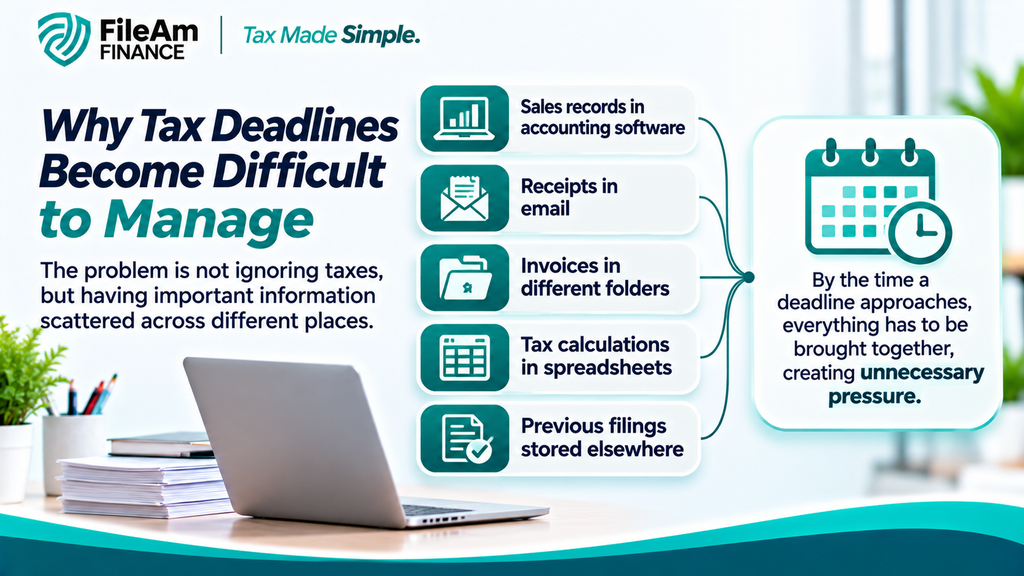
The problem is usually that the information needed to meet those deadlines is scattered.
A finance team may have:
- sales records in accounting software
- receipts in email
- invoices in different folders
- bank transactions in separate statements
- tax calculations in spreadsheets
- previous filings stored elsewhere
By the time a deadline approaches, someone has to bring everything together.
That creates unnecessary pressure.
A tax tracker can solve part of this problem, but the real value comes when tracking is connected to the financial information behind the deadline.
Instead of simply saying “VAT is due soon,” a smarter system should help answer:
How much VAT is due? Which transactions created it? Are the supporting records available? Has the return been prepared? Has it been filed?
That is where FileAm becomes more than a calendar.
What Should a Good Tax Tracker App Actually Track?
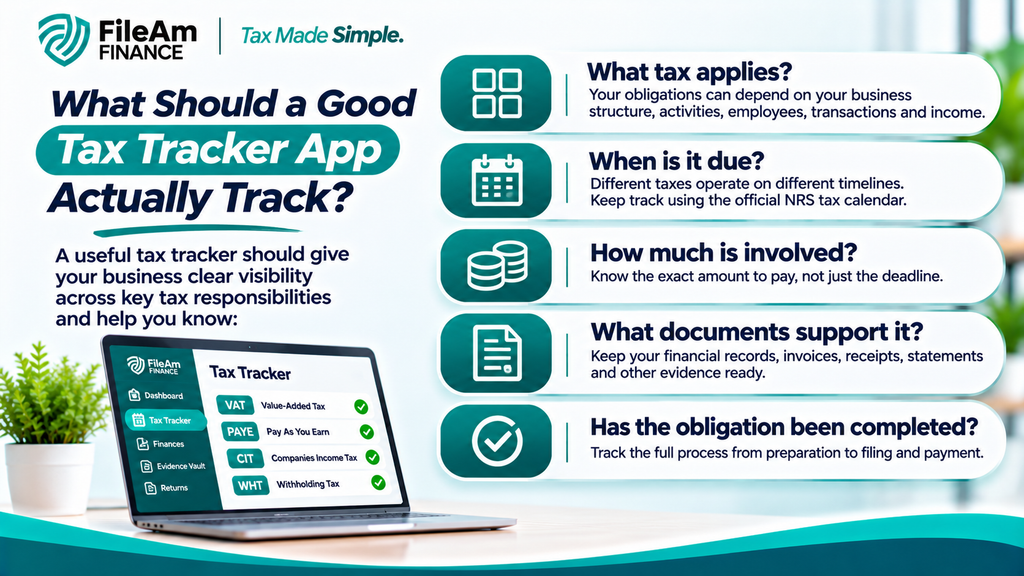
A useful Tax Tracker App should give businesses visibility across their major tax responsibilities.
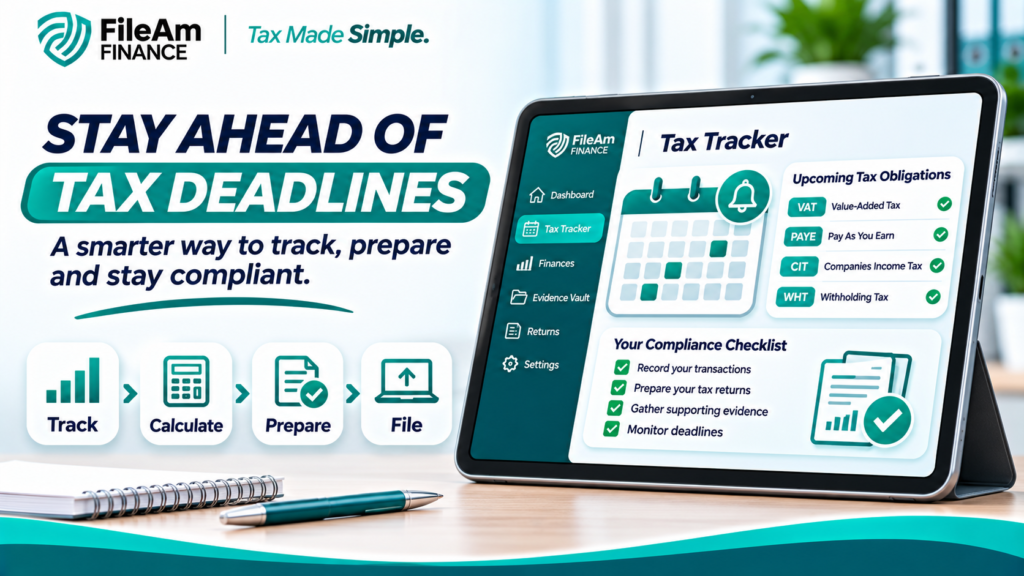
For example, FileAm is designed to track VAT, PAYE, CIT, and WHT throughout the year against the Nigeria Tax Act 2025.
This matters because tax compliance is not one single event.
A business needs to know:
What tax applies?
Your obligations can depend on your business structure, activities, employees, transactions, and income.
When is it due?
Different taxes operate on different filing and payment timelines. The Nigeria Revenue Service (NRS) maintains an official tax calendar and filing/payment deadline resources.
How much is involved?
A reminder without the underlying tax position is incomplete.
What documents support the amount?
Financial records, invoices, receipts, statements, and other evidence may be needed to support tax reporting.
Has the obligation been completed?
Tracking should continue from preparation through filing and payment—not stop at the reminder.
A Smarter Workflow: Track → Calculate → Prepare → File
The biggest difference between a basic tax reminder and a real tax management system is what happens after the reminder.
With FileAm, the workflow can start with recording your actual business activity.
You can log income and expenses, including through voice, while receipts and invoices can be captured and stored as supporting evidence. FileAm’s Evidence Vault can use OCR to extract information from receipts and connect the evidence to financial entries.
From there, your financial information feeds into your tax position. That creates a much more useful sequence:
Record your transactions → understand your tax position → prepare the relevant return → review it → complete the filing process → keep the evidence.
The deadline becomes the final stage of a process that has been running throughout the month or year.
Step 1: Track Your Financial Activity as It Happens
Tax preparation becomes difficult when businesses try to reconstruct an entire period at the end.
A better approach is to record transactions continuously.
FileAm allows users to record income and expenses, including through voice. This means a business owner can capture financial activity without relying entirely on spreadsheets or waiting until the end of the month.
For example, instead of remembering several sales later, the business can record them as they happen.
The same applies to expenses.
This creates a cleaner financial trail before tax calculations even begin.
Step 2: Let Your Tax Position Develop With Your Records
A Tax Tracker App becomes considerably more useful when it can connect financial activity to tax calculations.
FileAm provides live tax computation so users can see their current tax position as financial information is recorded. Its platform currently supports tracking for VAT, PAYE, CIT, and WHT.
This changes the question from:
“How much tax will I have to deal with later?”
to:
“What is my tax position right now?”
That visibility can help businesses plan cash flow and identify potential issues before filing periods become urgent.
Step 3: Keep the Evidence Behind the Numbers
Knowing your tax position is only part of compliance.
You also need to be able to support the information used to arrive at that position.
This is why document management matters inside a tax tracking workflow.
FileAm’s Evidence Vault allows users to capture receipts and extract details such as vendor, amount, date, and VAT information, while keeping the evidence connected to the relevant financial entry.
That means the system is not simply tracking a number.
It can help preserve the evidence behind the number.
For businesses, this becomes particularly useful when preparing returns or responding to future questions about financial records.
Step 4: Ask Tax Questions Before the Deadline
Another problem with tax management is that businesses often discover uncertainties when there is very little time left to resolve them.
For example:
- Is this expense treated correctly?
- Does this transaction attract VAT?
- How does a particular income source affect my tax position?
- What documentation should I keep?
- What does a particular tax rule mean?
FileAm includes TaxGPT, its AI tax assistant, which provides informational guidance based on Nigerian tax rules and cites the rules it relies on.
This gives businesses a way to investigate tax questions while they are managing their financial records rather than waiting until filing day.
TaxGPT is an informational tool, not a replacement for professional legal or accounting advice.
Step 5: Turn the Tax Position Into a Filing
Tracking a deadline is useful.
Being able to move from tracking to preparation and filing is much more useful.
FileAm includes filing workflows for VAT, PIT, CIT, and WHT schedules, with the information prepared in NRS format and users guided through the process step by step.
This connects the different stages of compliance.
Instead of using one tool to calculate tax, another place to store documents, and another process to manage filing, businesses can keep the workflow connected.
The goal is simple:
The information you track should help you complete the obligation you are tracking.
Step 6: Keep Payment and Compliance Status Visible
Filing is not always the end of a tax obligation.
Depending on the tax and circumstances, payment or remittance may also need to be completed.
Under Nigeria’s tax administration framework, tax due is generally required to be paid by the applicable due date, subject to the rules governing the particular obligation.
A good Tax Tracker App should therefore help businesses distinguish between:
- tax calculated
- return prepared
- return filed
- payment due
- payment completed
- compliance evidence stored
This provides a much clearer picture than a simple “deadline approaching” notification.
Why FileAm Is More Than a Tax Reminder
A traditional tax reminder answers one question:
“When is my tax due?”
FileAm is designed to answer a much broader set of questions:
What do I owe?
Why do I owe it?
What records support it?
What needs to be filed?
What do I need to do next?
The platform combines financial recordkeeping, live tax computation, document evidence, TaxGPT, filing workflows, and compliance tracking.
That makes the tax deadline part of a larger financial management process rather than an isolated calendar event.
A Tax Tracker Should Help You Prepare Before the Deadline
One of the most important principles of tax compliance is that preparation should happen before the deadline.
For example, the NRS provides an official self-service portal where taxpayers can manage activities including self-tax filing, payments, tax clearance, assessments, and refunds.
Businesses can therefore think of their compliance workflow in two connected layers:
Preparation layer:
Track transactions → calculate tax → organize evidence → review → prepare return.
Submission layer:
File → pay/remit where applicable → retain confirmation → monitor compliance status.
FileAm is particularly useful on the preparation side because it brings the underlying financial information, calculations, documents, and filing workflow together.
Why Businesses Should Stop Waiting Until Tax Day
- Waiting until a deadline is close creates several problems.
- Financial information may be incomplete.
- Receipts may be missing.
- Expenses may not have been properly categorized.
- Tax calculations may need to be reviewed.
- Management may not have approved the return.
And if a question arises, there may be little time to resolve it. A smarter Tax Tracker App changes this behaviour.
Instead of:
Deadline → panic → gather records → calculate → file
The workflow becomes:
Record → track → calculate → review → prepare → file → confirm
That difference can significantly reduce the pressure surrounding tax compliance.
What to Look for When Choosing a Tax Tracker App
Not every tax app provides the same level of functionality. Before choosing one, businesses should consider whether it can:
Track multiple tax obligations
A business should not need a different tracking system for every tax type.
Connect tax calculations to actual financial activity
The tax position should be based on the business records being maintained.
Store supporting evidence
Invoices, receipts, and financial documents should remain accessible.
Provide useful tax guidance
Users should have a way to understand tax questions before making filing decisions.
Support filing workflows
A tracker should ideally help move the business from calculation to filing.
Keep compliance visible throughout the year
The system should help businesses understand both current and upcoming obligations.
FileAm brings these capabilities together, including tax tracking, live tax computation, evidence storage, TaxGPT, filing workflows, and compliance management.
Tax Compliance Should Become a Routine, Not a Deadline Emergency
The real purpose of a Tax Tracker App is not to remind you that you have a tax obligation.
It is to make the obligation easier to manage.
When financial records are captured continuously, tax calculations can stay current. When supporting evidence is stored properly, filing preparation becomes easier. When tax questions can be answered early, uncertainty is reduced. And when filing is connected to the same workflow, fewer steps are left for the last minute.
That is the direction FileAm takes with tax management.
It is built to help Nigerian businesses and individuals move from scattered financial information to a clearer tax position and a more organized compliance process.
Conclusion
A Tax Tracker App should not simply tell you that a deadline is approaching.
It should help you stay ready for the deadline.
That means keeping financial activity organized, calculating your tax position, preserving supporting evidence, answering tax questions, preparing returns, completing filing steps, and maintaining a clear compliance history.
FileAm brings these activities into one connected financial and tax compliance platform, with support for VAT, PAYE, CIT, WHT, and other tax-related workflows.
The result is a better way to approach tax:
Track it. Understand it. Prepare it. File it. Stay compliant.