E-Invoicing in Nigeria: How Electronic Tax Invoices Work for Businesses
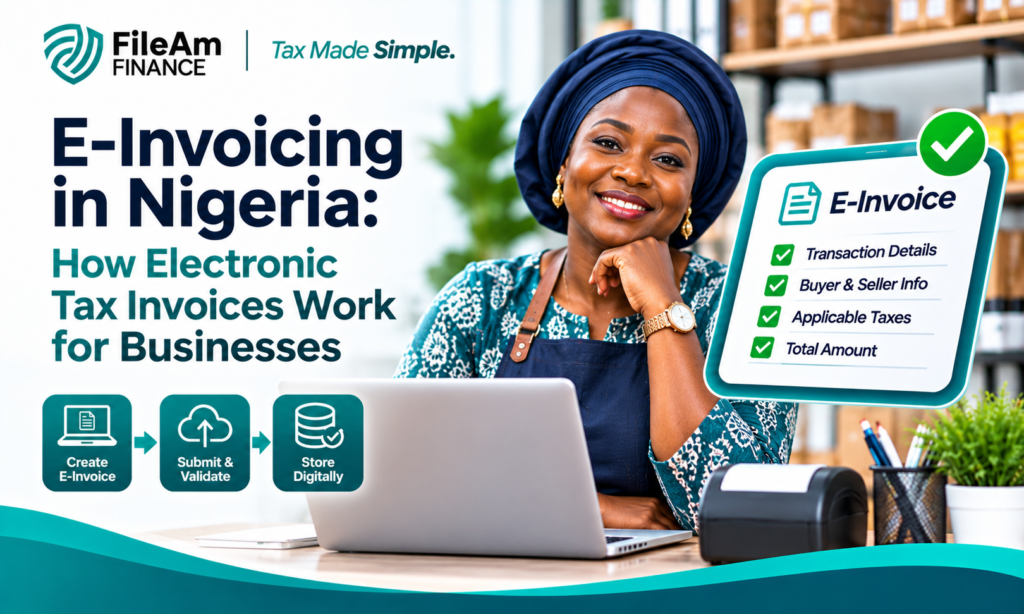
E-invoicing in Nigeria is becoming an important part of the country’s move toward digital tax administration.
For businesses, e-invoicing means more than replacing a paper invoice with a PDF. The current Nigeria Revenue Service (NRS) e-invoicing framework is designed around structured electronic invoices that can be created, submitted, validated, and stored digitally. The NRS is implementing e-invoicing in stages as part of the wider digitalisation of tax administration.
This matters because invoicing sits at the centre of many business activities. An invoice records a sale, supports accounting records, provides evidence for tax calculations, and helps businesses track what customers owe.
As electronic invoicing develops in Nigeria, businesses need to understand what an e-invoice is, how the process works, what information it contains, and how to prepare their existing invoicing systems.
What Is E-Invoicing in Nigeria?
E-invoicing is the electronic creation and exchange of structured invoice information between a supplier, buyer, and the relevant tax administration infrastructure.
The NRS e-invoicing system is designed to support the creation, submission, validation, and storage of electronic invoices. It supports both portal-based and API-based submission methods.
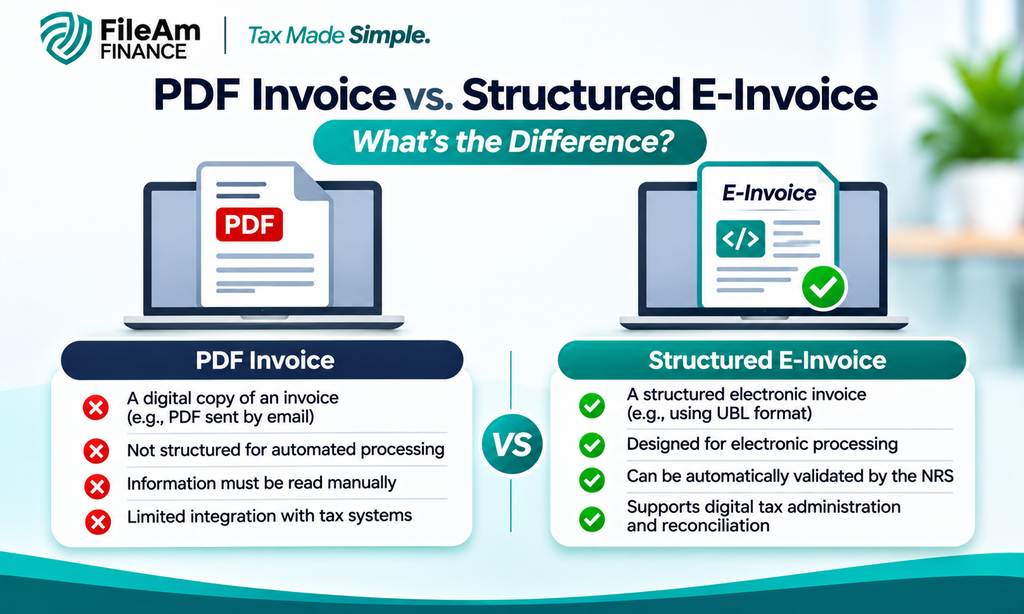
An important distinction is that an electronic invoice is not simply a PDF invoice sent by email.
A PDF can be opened and read electronically, but an e-invoice is structured so that invoice information can be processed electronically.
The NRS system uses defined invoice data structures and standards, including the Universal Business Language (UBL) framework for invoice data.
This makes it possible for invoice information to move between business systems and the tax administration infrastructure in a more standardized way.
How Does E-Invoicing Work in Nigeria?
The exact technical process can vary depending on whether a taxpayer uses the NRS portal directly or connects through an approved integration approach.
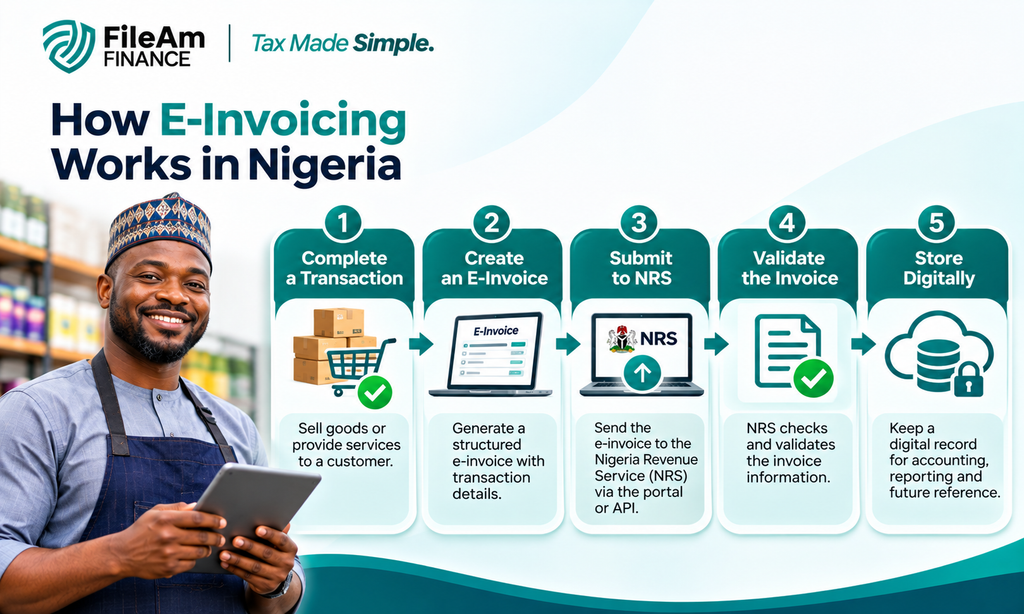
At a high level, the process works like this.
1. The Business Completes a Transaction
A supplier sells goods or provides services to a customer.
The business records information such as:
- Seller details
- Buyer details
- Invoice number
- Transaction date
- Goods or services supplied
- Quantities
- Prices
- Applicable taxes
- Total amount
Accurate transaction information is important because the invoice becomes part of the business’s financial and tax records.
2. The Electronic Invoice Is Created
The business generates the invoice using the applicable e-invoicing method.
The NRS system provides a portal-based option where taxpayers can create and submit invoices individually or upload multiple invoices using a predefined template.
Businesses with compatible systems can also use integration methods to connect their internal invoicing or accounting systems with the NRS e-invoicing infrastructure.
3. The Invoice Is Submitted for Validation
Where the NRS e-invoicing process applies, the invoice data is submitted to the NRS system for validation.
The system checks the information against the required structure.
If there are errors, the invoice can be flagged for correction.
If the invoice passes validation, the system can assign an Invoice Reference Number (IRN) and provide validation details.
4. The Invoice Is Shared With the Buyer
Following successful validation, the supplier and buyer can receive the relevant invoice information.
The NRS framework supports electronic invoice exchange and transaction tracking as part of its wider fiscalisation approach.
5. The Business Maintains the Records
The process does not end when the invoice is issued.
Businesses should retain:
- The invoice
- Supporting transaction evidence
- Payment information
- Relevant accounting records
- Related tax documentation
Keeping these records organized makes reconciliation, tax preparation, and future reviews easier.
Is a PDF Invoice the Same as an E-Invoice?
No.
This is one of the most important distinctions businesses need to understand.
PDF or Digital Invoice
A business can create an invoice as a PDF and send it through:
- A customer portal
- Other digital channels
The document is digital, but that does not automatically make it a structured e-invoice within the NRS framework.
Structured E-Invoice
An e-invoice contains structured information that can be processed electronically.
The NRS e-invoicing framework uses defined invoice schemas and standards to structure information such as transaction details, parties, amounts, quantities, and applicable tax information.
The difference can be summarized simply:
A PDF is a digital document. An e-invoice is structured transaction data designed for electronic processing.
Who Needs to Understand E-Invoicing in Nigeria?
Businesses should pay attention to e-invoicing if their activities fall within the applicable NRS implementation requirements.
The NRS has stated that e-invoicing is being implemented in stages, and its official platform provides specific enablement processes, exemptions, and implementation resources.
This means businesses should not assume that every taxpayer is subject to exactly the same e-invoicing process at the same time.
Companies should determine:
- Whether they are within the current implementation phase
- Whether they need to be enabled for e-invoicing
- Whether an exemption applies
- Which submission method is appropriate
- What technical requirements apply to their business
The NRS e-invoicing portal provides resources specifically covering implementation timelines and exemptions.
What Information Does an Electronic Tax Invoice Contain?
The information required depends on the applicable invoice schema and transaction.
Businesses should generally expect to manage information relating to:
- Supplier identification
- Buyer identification
- Tax identification information where required
- Invoice number
- Invoice date
- Description of goods or services
- Quantity
- Unit price
- Applicable tax information
- Total transaction value
- Payment information where applicable
The NRS schema also supports classifications such as B2B and B2C transactions, while its technical resources define standardized fields for invoice information.
Accuracy matters because incorrect invoice information can result in validation problems and create inconsistencies between invoicing, accounting, and tax records.
Why Is Nigeria Moving Toward E-Invoicing?
E-invoicing forms part of Nigeria’s broader shift toward digital tax administration.
The NRS describes its e-invoicing system as a tool for improving tax administration, transaction visibility, invoice validation, and fiscalisation.
For businesses, this transition can also create practical improvements.
More Structured Transaction Records
Electronic invoices provide businesses with standardized transaction information rather than relying entirely on paper documents or manually created files.
Easier Data Processing
Structured information can be processed by accounting and financial systems more efficiently than manually re-entering information from paper invoices.
Better Reconciliation
When invoice information is organized properly, businesses can more easily compare sales, invoices, payments, and accounting records.
Reduced Manual Errors
Standardized electronic processes can reduce some of the errors associated with repeated manual data entry.
Better Access to Records
Digital invoices can be stored and retrieved without relying entirely on physical documents.
Common E-Invoicing Challenges for Nigerian Businesses
Moving from traditional invoicing to electronic invoicing can create practical challenges.
Incomplete Customer Information
Businesses may not always have accurate customer identification or tax information.
Incorrect Invoice Data
Errors in quantities, prices, tax calculations, or invoice details can cause inconsistencies.
Poor Invoice Numbering
Businesses should maintain a consistent invoice numbering system that makes individual transactions easy to identify.
Scattered Financial Records
An e-invoice is only one part of the transaction.
If the corresponding payment, receipt, expense, or accounting record is stored somewhere else, reconciliation can still become difficult.
Lack of System Integration
Businesses that issue many invoices may find manual entry inefficient.
The NRS framework provides API and integration options for businesses and system providers that need to connect existing systems with the e-invoicing infrastructure.
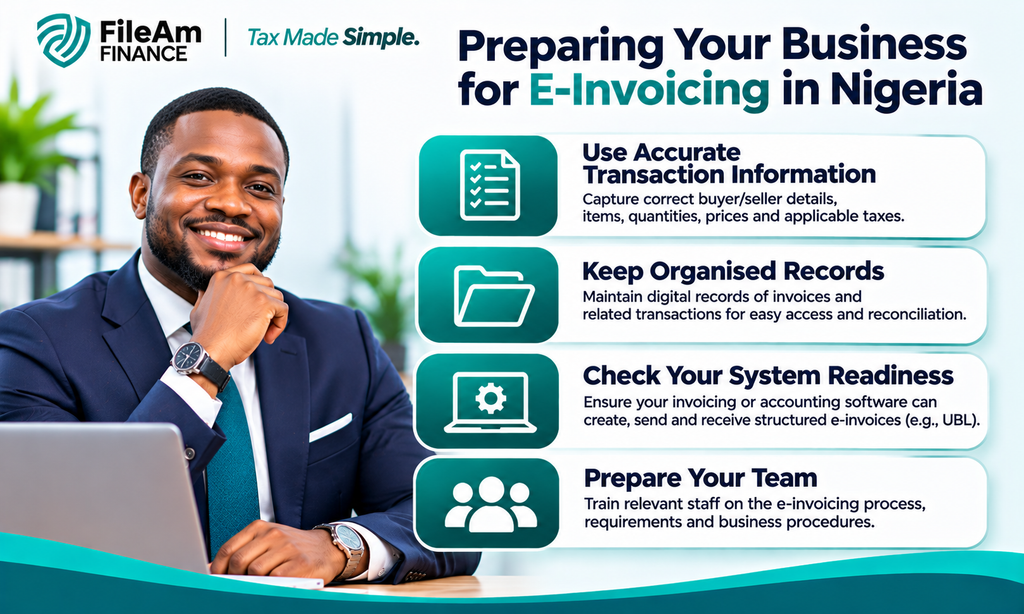
How Businesses Can Prepare for E-Invoicing in Nigeria
Businesses do not need to wait until implementation becomes urgent before preparing.
Review Your Current Invoicing Process
Understand how invoices are currently:
- Created
- Numbered
- Sent
- Stored
- Matched with payments
Standardize Business Information
Ensure your company details, customer information, tax identification information, and invoice records are accurate.
Organize Financial Records
Invoices should connect logically with sales, payments, expenses, and accounting records.
Reduce Manual Data Entry
If your business handles a large number of transactions, consider how accounting or financial systems can reduce repetitive entry.
Train Finance and Administrative Staff
Employees responsible for invoicing should understand the information required and the workflow they need to follow.
Monitor NRS Updates
E-invoicing is evolving. The NRS publishes implementation updates, technical changes, resources, and enablement information through its official e-invoicing platform.
Businesses should rely on current NRS guidance when determining their specific implementation requirements.
How FileAm Can Help Businesses Organize Their Invoicing Records
E-invoicing involves more than generating an invoice. Businesses also need to keep the financial information behind those invoices organized.
FileAm’s Inventory & Invoices functionality can help businesses create and track invoices while keeping sales and receivables more visible.
This can be useful for businesses that want their invoicing activity connected to their broader financial records rather than maintaining invoices separately from the rest of their business data.
For supporting evidence, Evidence Vault can help businesses capture and organize receipts and transaction evidence.
The purpose is not to replace the NRS e-invoicing infrastructure. Instead, FileAm can help businesses keep their own financial and transaction records organized so that invoicing and tax-related preparation is easier to manage.
E-Invoicing vs Traditional Invoicing
The difference becomes clearer when the two approaches are compared.
| Traditional Invoicing | E-Invoicing |
|---|---|
| Often paper or manually created digital documents | Structured electronic invoice data |
| May require manual data entry | Designed for electronic processing |
| Records may be stored across different locations | Can be stored and retrieved digitally |
| Reconciliation may require manual work | Structured data can support easier reconciliation |
| Tax information may need separate processing | Can connect with applicable digital tax administration processes |
The key difference is not simply whether an invoice is digital.
It is whether the invoice is created and exchanged in a structured electronic format that supports automated processing and applicable tax administration requirements.
E-Invoicing Nigeria: Practical Business Checklist
Before your business begins working with applicable e-invoicing requirements, check that:
- Business identification information is accurate
- Tax ID information is correct where required
- Customer information is properly recorded
- Invoice numbering is consistent
- Product and service descriptions are accurate
- Prices and quantities are correctly recorded
- Applicable taxes are correctly calculated
- Supporting transaction evidence is retained
- Invoice and payment records can be reconciled
- Staff responsible for invoicing understand the process
- Your business has checked whether current NRS e-invoicing requirements apply
- Your invoicing system can support the required workflow
Frequently Asked Questions About E-Invoicing in Nigeria
What is e-invoicing in Nigeria?
E-invoicing is the electronic creation and processing of structured invoice information. Nigeria’s NRS is implementing an e-invoicing system in stages to support digital tax administration and fiscalisation.
Is a PDF invoice an e-invoice?
Not necessarily. A PDF is a digital document, while an e-invoice is structured electronic data designed for electronic processing.
Is e-invoicing mandatory for every Nigerian business?
Not necessarily at the same time or under the same conditions. The NRS is implementing e-invoicing in stages and provides specific implementation timelines and exemptions. Businesses should verify their current status and applicable requirements directly with the NRS.
How does an e-invoice get validated?
Under the NRS workflow, the supplier submits the invoice for validation. The system checks the invoice information and, when successfully validated, assigns an Invoice Reference Number (IRN) and validation details.
Can businesses connect their accounting systems to NRS e-invoicing?
Yes. The NRS provides API-based integration options for system integrators and taxpayers using compatible systems.
How can a business prepare for e-invoicing?
Start by reviewing your invoicing process, ensuring business and customer information is accurate, organizing financial records, training staff, and checking the current NRS implementation requirements that apply to your business.
Conclusion
E-Invoicing Is More Than Going Paperless. E-invoicing Nigeria is part of a broader move toward structured digital transaction reporting and modern tax administration.
For businesses, the transition is not simply about replacing paper invoices with electronic documents. It requires accurate transaction data, organized financial records, appropriate systems, and an understanding of the requirements that apply to the business.
The NRS provides the official e-invoicing infrastructure, implementation guidance, enablement process, and technical standards. Businesses should use current NRS guidance to determine their specific obligations.
For the business itself, preparation starts with something more fundamental: knowing where every invoice, transaction, payment, and supporting record belongs.
When those records are organized from the beginning, adapting to electronic invoicing becomes much easier.